
The FDA doesn’t guess when a foodborne illness breaks out. It doesn’t wait weeks to trace back where contaminated lettuce came from. Instead, it uses something called the Traceability Lot Code - or TLC - to find the exact source of a problem in hours, not days. This system, born from the Food Safety Modernization Act (FSMA) in 2022, changed how food gets tracked from farm to table. And it’s not just paperwork. It’s a lifeline.
What Is a Traceability Lot Code (TLC)?
A TLC is a unique code - usually a mix of letters and numbers - assigned to a batch of food at key moments in its journey. Think of it like a birth certificate for a shipment of spinach or a carton of eggs. Unlike old-school lot numbers that companies used internally for quality checks, a TLC must be passed along the entire supply chain. When a foodborne illness hits, the FDA can ask for that code and instantly see every stop the product made: where it was packed, who shipped it, where it was stored, and who sold it.
The FDA doesn’t let companies pick any code they want. The code must be unique within the food system, not just inside one company’s database. That means if two farms use the same code, it’s a problem. The code must also stay the same unless the food changes form - like when tomatoes are chopped into a salad mix. Then, the new processor creates a new TLC but must link it back to the original.
Where and When Is the TLC Assigned?
The rule is strict about when and where this code gets applied. There are only three points in the supply chain where a TLC must be assigned:
- When raw agricultural commodities - like leafy greens or onions - are first packed (except seafood from fishing vessels).
- When seafood from fishing vessels reaches land for the first time.
- When food is transformed - meaning it’s chopped, cooked, mixed, or repackaged into a new product.
This is a big shift. Before, companies might assign lot codes at every step - packing, shipping, warehousing - just to keep internal tabs. Now, the TLC only gets added at these three critical points. That cuts down on clutter and confusion. It also means if a problem shows up, investigators don’t have to dig through dozens of codes. They follow one clear trail.
What Data Is Linked to the TLC?
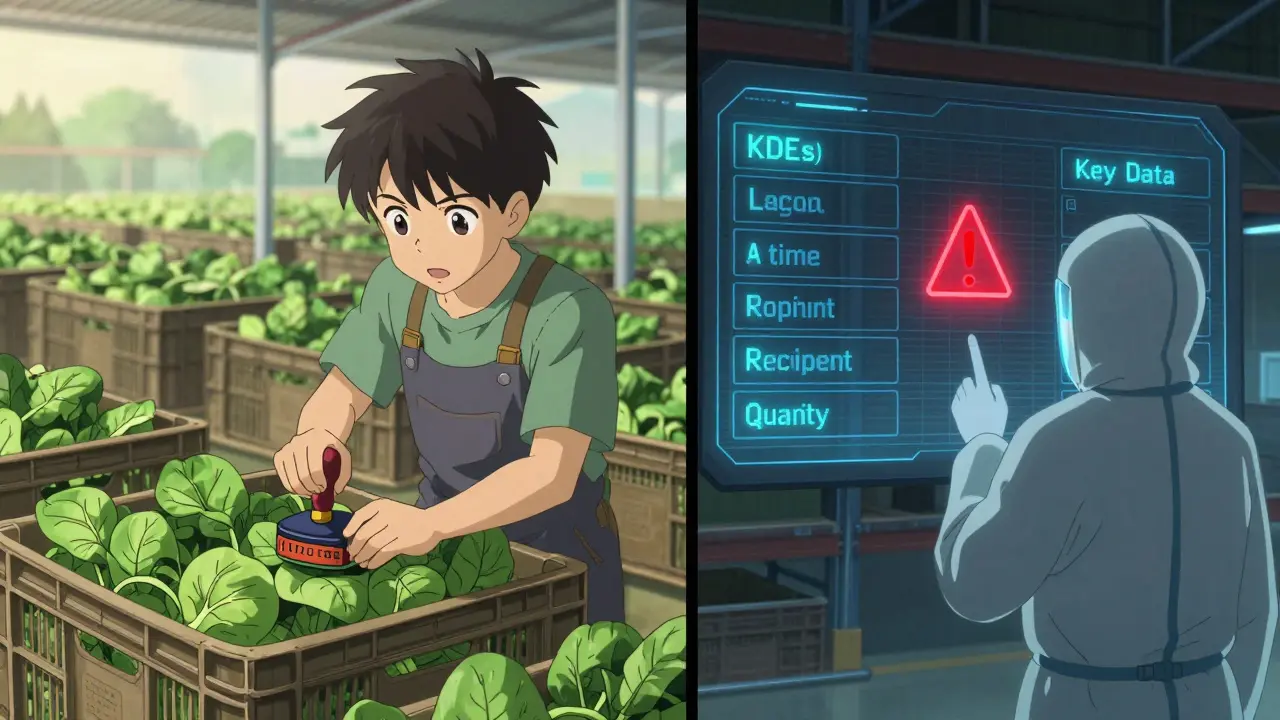
The TLC itself is just the starting point. It’s tied to seven other key data elements - or KDEs - that paint the full picture of the product’s journey:
- The TLC source (where and when it was assigned)
- Product description (what the food is)
- Quantity and unit of measure (how much was shipped)
- Transaction information (who sent it, who received it, when)
- Location of each handling event
- Time stamps for each transfer
- Any changes made to the product (like blending or repackaging)
When the FDA requests records during an outbreak, companies have 24 hours to deliver all of this data. It doesn’t have to be on a fancy system - paper records are still allowed. But if you use digital records, they must be sortable and exportable in common formats like CSV. No locked-down software. No proprietary formats. The FDA needs to be able to read it.
Which Foods Are Covered?
Not everything is tracked. The FDA drew a line with the Food Traceability List (FTL). This list includes high-risk foods that have caused the most outbreaks. Right now, it covers:
- Leafy greens (lettuce, spinach, kale)
- Tomatoes
- Onions
- Fresh-cut fruits and vegetables
- Cheeses (especially soft cheeses)
- Eggs
- Nut butters
- Certain seafood like shrimp, crab, and mollusks
These foods make up about 15% of the U.S. food supply by volume - but they’re responsible for nearly half of all foodborne illnesses. The FDA chose them based on outbreak data from the last 15 years. Melons, for example, are not on the list yet - even though they’ve been linked to outbreaks - because the agency is still reviewing them. Critics say that’s a gap. The FDA says it’s just the first step.
How Is This Different from Old Systems?
Before the TLC, companies used their own lot codes. Some followed the Produce Traceability Initiative (PTI), which used GS1 barcodes. But PTI was voluntary. If a company didn’t use it, there was no penalty. The FDA couldn’t force them to share data.
The TLC changes that. It’s mandatory for FTL foods. And unlike the Drug Supply Chain Security Act (DSCSA) for medicines - which tracks every single pill - the TLC works at the lot level. One code for a truckload of spinach, not each individual bag. That keeps it practical for bulk food.
One major concern from industry? Tandem coding. Companies worried they’d have to keep both their old internal codes and the new TLC. The FDA heard that. In response, they made it clear: your existing code can be your TLC - if it meets the rules. No need for double work. Just make sure it’s unique, traceable, and passed along.
How Fast Does It Work?
Before TLC, tracing a contaminated product could take weeks. Investigators had to call dozens of suppliers, dig through paper logs, and guess where contamination happened. Now, with digital records and a single code, the FDA can trace back to the source in under 24 hours.
That speed saves lives. The FDA estimates that better traceability could cut foodborne illness outbreaks by 20-30%. In pilot programs from 2019 to 2021, they saw outbreaks resolved 60% faster. One case in 2021 showed a single contaminated batch of romaine lettuce being traced back to a farm in California within 17 hours. Without the TLC, it would have taken over 10 days.
Who Has to Comply - and When?
The rule applies to any business that manufactures, processes, packs, or holds food on the FTL. That’s about 15,000 facilities across the U.S. - from small farms to giant food processors.
Initial compliance was set for January 20, 2026. But in September 2023, the FDA proposed pushing that deadline to July 20, 2028. Why? Because many companies, especially small ones, said they needed more time. The FDA agreed. This extension gives businesses nearly two extra years to build systems, train staff, and update software.
Still, 78% of produce companies surveyed in early 2023 had already made changes. Many upgraded their ERP systems. Others bought traceability software. A few still use spreadsheets - but they’re risky. The FDA doesn’t care how you do it, as long as the data is accurate and accessible.
What Happens If You Don’t Comply?
The FDA doesn’t have a fine system like the EPA. Instead, they use enforcement tools: warning letters, import alerts, and product seizures. If you can’t produce TLC records during an investigation, your product could be pulled from shelves. Retailers like Walmart and Kroger already require TLC compliance from suppliers. If you don’t meet the standard, you lose contracts.
For small farms, the FDA offers help. The Traceability Assistance Program launched in January 2023 gives free technical support, templates, and training. The 2023 Farm Bill also set aside $25 million to help small businesses get ready.
What’s Next?
The system isn’t finished. The FDA is working on standardized data formats for KDEs - expected in mid-2024. That means every company will eventually send data in the same way, making it easier to compare and analyze. Blockchain and IoT sensors are being tested too. Imagine a sensor on a pallet of spinach that logs temperature and location in real time - and links that data to the TLC.
Internationally, the EU is launching its own Digital Product Passport. It’s similar, but not the same. The FDA is talking with European regulators to align standards. That’s important - because food doesn’t stop at borders.
One thing’s clear: the TLC isn’t perfect. But it’s the most powerful tool the U.S. has ever had to stop foodborne illness before it spreads. It’s not about control. It’s about safety. And for families eating dinner, that’s everything.
What foods are covered by the FDA’s Traceability Lot Code system?
The FDA’s Traceability Lot Code system applies to foods on the Food Traceability List (FTL), which includes leafy greens, tomatoes, onions, fresh-cut fruits and vegetables, cheeses, eggs, nut butters, and certain seafood like shrimp and mollusks. These are high-risk foods linked to the most frequent outbreaks. Melons and other items are under review for future inclusion.
Do I need a new lot code if I already have one?
No, you don’t need a new code if your existing lot code meets the FDA’s requirements. The FDA allows companies to use their current internal lot codes as the Traceability Lot Code (TLC), as long as it’s unique across the supply chain and properly passed along with each transaction. You just need to document how you generate and track it.
How does the FDA get the traceability data during an outbreak?
When the FDA investigates a foodborne illness, they issue a formal request for records. Companies must provide all Key Data Elements (KDEs) linked to the Traceability Lot Code within 24 hours. This includes where the product was handled, who received it, when, and in what quantity. Records can be paper or digital - but digital ones must be exportable in standard formats like CSV.
Is blockchain required for TLC compliance?
No, blockchain is not required. The FDA does not mandate any specific technology. Companies can use ERP systems, specialized software, spreadsheets, or even paper records - as long as they can produce the required data quickly. Some large retailers like Walmart use blockchain voluntarily, but it’s not part of the FDA’s rule.
What happens if a company can’t provide TLC records?
If a company fails to provide TLC records during an FDA investigation, the agency can issue warning letters, place import alerts on their products, or seize contaminated shipments. Retailers and distributors may also cut ties with non-compliant suppliers. For small businesses, the FDA offers free assistance, but compliance is still mandatory for all entities handling FTL foods.
8 Responses
I never realized how much chaos traceability used to be. I work in a small organic co-op in Ireland, and we’ve been using GS1 barcodes since 2020. The TLC system feels like a breath of fresh air - no more guessing which lot went to which store after a recall. It’s not perfect, but it’s finally a system that actually works in real time.
One thing I wonder: what happens when a shipment gets split? Like, a pallet of spinach goes to three different distributors. Does each one get the same TLC, or does the first handler break it into sub-codes? The rule doesn’t spell that out clearly.
As someone who’s helped small farms in India adopt digital record-keeping, I can say this TLC system is a game-changer - even outside the US. We’ve got similar challenges with traceability, and seeing the FDA set a clear, enforceable standard gives us a blueprint. The fact they allow paper records? That’s huge for places where internet access is spotty.
Also, props to the FDA for not forcing blockchain. Too many tech companies push solutions that solve problems nobody actually has. This is pragmatic, not flashy.
It’s funny… we talk about food safety like it’s a technical problem, but really, it’s about trust.
Before this, when something went wrong, no one knew who to believe. Farmers blamed processors. Distributors blamed retailers. Retailers blamed consumers for not washing their greens. Now, there’s a paper trail - literally or digitally - that doesn’t lie. It doesn’t solve the fear, but it gives us something solid to hold onto.
I think the real win isn’t the 24-hour trace. It’s that parents can finally stop wondering if the salad they served their kids was safe. That’s quiet, invisible heroism.
Oh THANK GOD someone finally did something about this. I’ve been screaming into the void for years about how the FDA was letting companies get away with murder. I mean, come ON - before this, a single outbreak could take 10 DAYS to trace? That’s not incompetence, that’s negligence. And now? We’ve got a system where one code can shut down a whole supply chain in hours?
And let’s be real - the fact that they’re not forcing blockchain is proof they listened to actual people, not consultants who charge $500/hour to say ‘blockchain!’
But wait - what about the 22% of farms that STILL use handwritten logs on napkins? Are we just gonna let them keep doing that? That’s a lawsuit waiting to happen. I’ve seen food safety audits. Half the time, the records are written in crayon. I’m not joking. CRAYON. I have photos. I could post them. Someone should. This is a public health emergency.
Also, why is melon still not on the list? You think salmonella doesn’t grow on cantaloupe? I’ve got a cousin who got sick from one. She’s still on disability. I’m not letting this slide. Someone needs to answer this. NOW.
The FDA’s Traceability Lot Code framework represents a paradigmatic shift in supply chain governance, leveraging standardized Key Data Elements (KDEs) to enable deterministic溯源 (traceability) across heterogeneous nodes. The exclusion of blockchain is not a technological regression but a deliberate architectural choice - prioritizing interoperability over vendor lock-in. By mandating CSV-exportable formats, the agency effectively de-escalates the technical burden on SMBs while preserving audit trail integrity.
That said, the 2028 compliance deadline is a regulatory capitulation. Given that 78% of producers have already adapted, the delay undermines the urgency of public health imperatives. The FTL’s omission of melons is a glaring omission - particularly given the 2011 Listeria outbreak linked to cantaloupes. This is not a gap - it’s a vulnerability.
This is what happens when the government finally does something right for once. No more waiting weeks for answers. No more corporate cover-ups. If you can’t prove where your food came from, you shouldn’t be selling it. Period. The FDA got this right. Stop complaining and get with the program.
Let’s be honest - this isn’t about safety. It’s about control.
The FDA doesn’t care about small farms. They care about standardization. They care about data collection. They care about having a centralized, digital log of every single movement of food - and don’t think for a second that this isn’t being fed into some federal database. The fact that they allow paper records? That’s a trap. They want you to use digital systems so they can track you. And then what? Who owns this data? Can it be subpoenaed? Can it be sold? Can it be used to audit your soil, your fertilizer, your water usage?
I’m not anti-regulation. I’m anti-surveillance. And this? This is surveillance disguised as safety. The 24-hour traceability sounds great - until you realize it’s not just tracking your product. It’s tracking your business. Your life.
I’ve seen what happens when governments get this kind of power. It doesn’t end with food. It ends with everything.
I’ve been in this industry for 20 years. I’ve seen every system fail. I’ve seen recalls that took months. I’ve seen kids get sick because no one knew where the spinach came from. This TLC thing? It’s the first thing that actually makes sense. I don’t care if it’s perfect. I care that it works. And it does. I’ve used it. My company saved $1.2 million in avoided recalls last year. That’s real. That’s not theory. That’s life.