

INR Risk Calculator for Warfarin Patients
INR Risk Calculator
This tool estimates how trimethoprim-sulfamethoxazole (Bactrim) could increase your INR based on medical research. The interaction can raise your INR by 1.5-2.5 points within 2-3 days.
Risk Assessment Results
Important: This is an estimate based on medical research. Always consult your anticoagulation specialist or healthcare provider before making any changes to your medication.
Research shows that the INR typically rises within 24 hours and peaks between 36 and 72 hours after starting Bactrim. If your INR is elevated, check it within 48 hours.
When you're on warfarin, even a simple antibiotic can turn dangerous. Trimethoprim-sulfamethoxazole - sold as Bactrim, Septra, or co-trimoxazole - is one of the most commonly prescribed antibiotics for urinary tract infections, sinus infections, and pneumonia. But if you're taking warfarin for atrial fibrillation, a mechanical heart valve, or deep vein thrombosis, this combo can push your INR into the danger zone - fast.
Why This Interaction Isn't Just a Warning on a Label
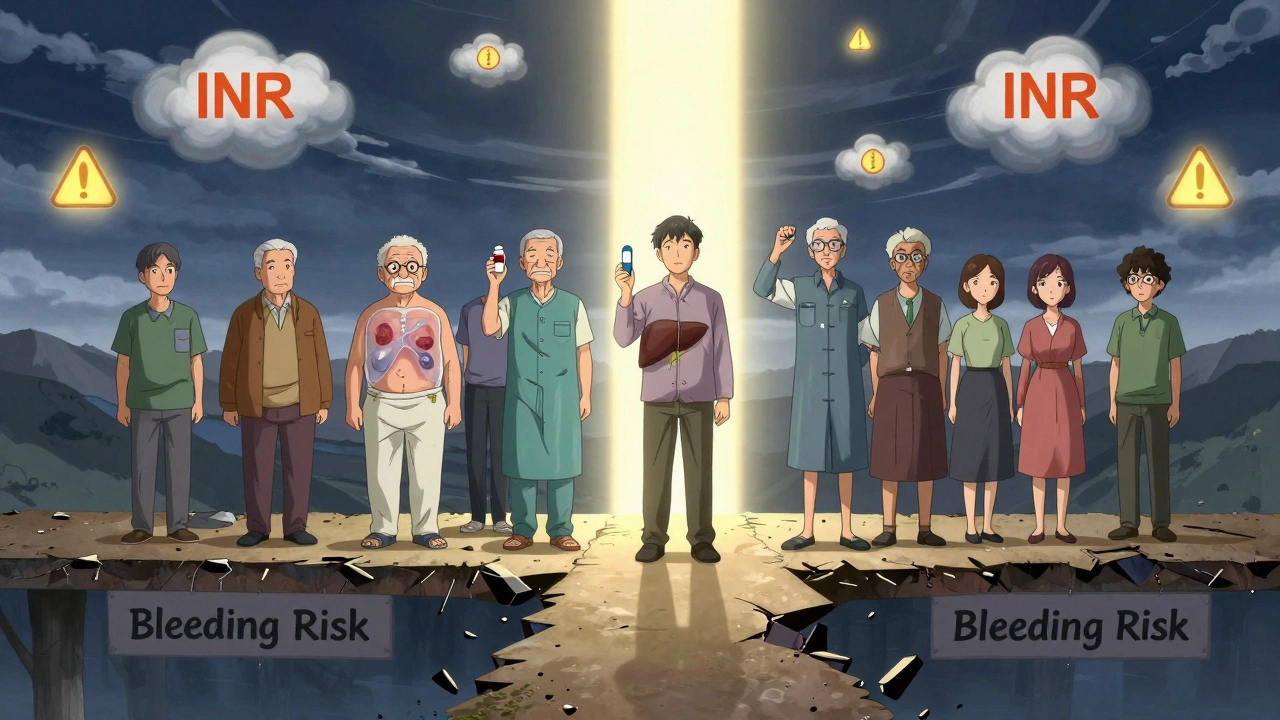
Warfarin works by blocking vitamin K, which your body needs to make clotting factors. It's a tightrope walk: too little, and you risk clots; too much, and you bleed. Your INR tells you where you stand. Normal therapeutic range is usually 2.0 to 3.0. But when TMP-SMX enters the picture, INR can jump 1.5 to 2.5 points within just 2 to 3 days. That means an INR of 2.8 can become 5.3 - a level where spontaneous bleeding becomes a real threat.
The problem isn't one thing - it's three things happening at once. First, trimethoprim blocks CYP2C9, the main liver enzyme that breaks down the powerful S-warfarin molecule. That means warfarin builds up in your blood. Second, sulfamethoxazole pushes warfarin off albumin proteins in your bloodstream, making more of it free and active. Third, both drugs can reduce vitamin K-producing gut bacteria, further lowering your body’s ability to clot.
This isn't theoretical. A 2023 study tracking over 70,000 warfarin users found that those who took TMP-SMX had an average INR increase of 1.8 points. Compare that to amoxicillin, which raised INR by just 0.4 points. The difference isn't subtle - it's life-or-death.
Who's at Highest Risk?
Not everyone reacts the same way. Some people take Bactrim and their INR barely moves. Others - often older, frailer, or with liver issues - see dramatic spikes.
High-risk groups include:
- People over 75
- Those with heart failure or liver disease
- Patients with poor nutrition or low vitamin K intake
- Men (studies show they’re 9% more likely than women to have dangerous INR spikes)
- Anyone with a mechanical heart valve - where INR targets are higher (usually 2.5-3.5) and bleeding is catastrophic
One real case from a Reddit thread: a 78-year-old man with a mechanical aortic valve had his INR jump from 2.9 to 8.2 after three days of Bactrim for a chest infection. He ended up in the ER with internal bleeding and needed vitamin K and fresh frozen plasma. He survived - but barely.
What the Experts Say - And What They Don’t
The American Heart Association, the American College of Chest Physicians, and the Institute for Safe Medication Practices all label this interaction as high-risk. Dr. Gregory Makris, a leading hematologist, says: "TMP-SMX should be considered contraindicated in patients on warfarin unless absolutely necessary."
But here’s the catch: doctors still prescribe it. Why? Because it’s cheap, effective, and widely available. A 2022 JAMA study found nearly 1 in 5 warfarin patients got an interacting antibiotic within 30 days - and TMP-SMX made up nearly 3 out of 10 of those cases.
Some experts, like Dr. Jack Ansell, argue that with careful monitoring, short-term use can be managed. But that’s not the same as saying it’s safe. It’s like driving with one hand on the wheel - you might make it, but you’re gambling.

How to Handle It - Step by Step
If you're on warfarin and your doctor says you need an antibiotic, here’s what actually works:
- Ask: Is there an alternative? For UTIs, nitrofurantoin or fosfomycin are safer. For sinus infections, amoxicillin or doxycycline are better choices. Don’t accept Bactrim without asking.
- Get your INR checked before starting. Know your baseline. If it’s already near 3.0, you’re on thin ice.
- Check INR again within 48 to 72 hours. That’s when the spike hits. Don’t wait for symptoms.
- Reduce your warfarin dose preemptively. In high-risk patients, lowering the dose by 20-30% before starting TMP-SMX can prevent a crash. Your anticoagulation clinic should guide this.
- Watch for bleeding signs. Unexplained bruising, nosebleeds, blood in urine or stool, headaches, dizziness - these aren’t "just aging." They’re red flags.
If your INR hits 4.0-5.0 with no bleeding, skip 1-2 warfarin doses and recheck in 2 days. If it’s above 5.0 and you’re bleeding, take 1-2.5 mg of oral vitamin K immediately and call your doctor. If it’s over 10 - or you’re vomiting blood - go to the ER. You may need IV vitamin K and prothrombin complex concentrate.
Why This Still Matters in 2025
You might think: "Don’t we use DOACs now?" Yes - and that’s great. But over 2.6 million Americans still take warfarin. That includes nearly 1.2 million people with mechanical heart valves who must stay on it - DOACs don’t work for them. And TMP-SMX is still the 47th most prescribed antibiotic in the U.S.
Even worse, many patients don’t know this interaction exists. The National Blood Clot Alliance found that patients who got specific education about antibiotic risks had 37% fewer emergency visits for bleeding. That’s not just helpful - it’s life-saving.
What to Do Right Now
If you’re on warfarin:
- Keep a list of all your meds - including over-the-counter drugs and supplements - and show it to every doctor.
- Ask your pharmacist: "Is this antibiotic safe with warfarin?" They’re trained to catch this.
- Set a calendar alert for INR checks if you’re ever prescribed an antibiotic.
- If you’ve ever had a sudden INR spike after an antibiotic, tell your anticoagulation clinic. It’s valuable data.
If you’re a caregiver for someone on warfarin, don’t assume "it’s just a pill." A single antibiotic can change everything. Be the person who asks the hard questions.
What’s Next?
Researchers are building tools to predict who’s most at risk. A 2023 algorithm using age, CYP2C9 gene type, and baseline INR predicted dangerous spikes with 82% accuracy. Soon, your blood test might come with a warning: "High risk for TMP-SMX interaction. Avoid or monitor closely." For now, the message is simple: Don’t take TMP-SMX with warfarin unless you have no other option - and even then, monitor like your life depends on it. Because it does.
Can I take Bactrim if I’m on warfarin?
It’s not recommended. Bactrim (TMP-SMX) can cause your INR to spike dangerously within 2-3 days, increasing bleeding risk. Only use it if no safer alternative exists - and only with close INR monitoring.
How soon after taking Bactrim does INR rise?
INR typically starts rising within 24 hours and peaks between 36 and 72 hours after starting Bactrim. That’s why checking your INR within 48 hours is critical.
What antibiotics are safe with warfarin?
Amoxicillin, doxycycline, and nitrofurantoin are generally considered safer. Fosfomycin is a good option for UTIs. Avoid fluoroquinolones like ciprofloxacin and macrolides like erythromycin - they also raise INR, just not as much as TMP-SMX.
What should I do if my INR jumps to 6.0?
If you have no bleeding, skip 1-2 warfarin doses and take 1-2.5 mg of oral vitamin K. Recheck INR in 24-48 hours. If you’re bleeding - even mildly - go to the ER. You may need IV vitamin K and clotting factor concentrate.
Do DOACs avoid this interaction?
Yes - direct oral anticoagulants (like apixaban or rivaroxaban) don’t interact with TMP-SMX the same way. But DOACs aren’t an option for everyone - especially those with mechanical heart valves. If you’re on warfarin, you’re still at risk.
11 Responses
This is the kind of post that saves lives. I’m a nurse and I’ve seen too many older patients end up in the ER because no one told them Bactrim wasn’t safe with warfarin. Just last month, a 79-year-old woman bled internally after her UTI script. She survived, but barely. Please, if you’re on warfarin-ask before you pick up that antibiotic. It’s that simple.
Great breakdown. I’ve been on warfarin for 12 years after a valve replacement. I always ask my pharmacist first-no exceptions. Nitrofurantoin for UTIs, doxycycline for sinus stuff. Avoid TMP-SMX like it’s radioactive. And yeah, check your INR 48 hours after starting any new med. It’s not paranoia, it’s protocol.
You Americans are so dramatic! In India, we prescribe TMP-SMX with warfarin daily-no problem! You have no idea how over-medicalized your system is. We trust our doctors, not some American study that says 'danger zone'. Your INR is too high because you eat too much kale and take vitamin K supplements. Stop being paranoid!
Let’s be precise: TMP-SMX doesn’t just inhibit CYP2C9-it also suppresses gut flora that synthesize vitamin K2, which is distinct from K1 and far more bioavailable. Furthermore, sulfamethoxazole’s displacement of warfarin from albumin is a pharmacokinetic phenomenon often misattributed to 'increased free fraction' without acknowledging the role of binding affinity constants (Kd). The 2023 JAMA study? Underpowered. The real danger lies in the heterogeneity of CYP2C9*2 and *3 polymorphisms, which are grossly under-screened in primary care. If you’re not genotyping your patients, you’re not practicing medicine-you’re guessing.
Thank you for this meticulously researched and clearly articulated post. The clinical implications are profound. I am a retired physician, and I wish more providers would treat this interaction with the gravity it deserves. The fact that nearly one in five warfarin patients still receives an interacting antibiotic speaks to systemic gaps in communication and education-not just among patients, but among prescribers as well.
It’s not the antibiotic. It’s the system. We’re all just lab rats in a pharmaceutical game. They sell Bactrim because it’s cheap. They sell warfarin because it’s profitable. They don’t care if you bleed. They just want your co-pay.
wait u mean bactrim isnt safe with warfarin?? i took it last month and my inr went to 6.5 but i was fine?? maybe its just a myth??
THIS IS A GOVERNMENT COVER-UP. The FDA knew about this interaction since 1987. They buried the data because Big Pharma owns the AMA. My cousin died after taking Bactrim. The hospital said 'natural causes'. I found the autopsy report. It said 'hemorrhagic stroke due to warfarin toxicity'. They didn't even test for TMP-SMX. They didn't want to admit it. They're all in on it. I'm filing a FOIA request. Join me.
I’m so glad you wrote this. My mom’s on warfarin and she’s 81. I printed this out and gave it to her doctor. He actually thanked me. She’s been on amoxicillin for her last two infections. I know it sounds small, but asking questions? That’s how you protect the people you love. You’re not being annoying-you’re being brave.
so like... if i take bactrim and dont bleed, does that mean its fine? my aunt did it and she’s still alive??
To everyone who says ‘I took it and was fine’-you’re lucky, not right. This isn’t about your experience. It’s about risk. One person surviving a 7.8 INR doesn’t negate the 47 others who bled out silently in their sleep. I’ve worked in anticoagulation for 18 years. I’ve seen the bodies. I’ve held the hands of families who didn’t know their grandma’s antibiotic could kill her. This isn’t a debate. It’s a public health emergency. Please-don’t normalize risk. Educate. Advocate. Question. And if you’re on warfarin? Don’t let anyone talk you into Bactrim. Not even your doctor.