
You might feel perfectly fine. You aren't losing weight rapidly, your hands aren't shaking, and you don't have that wired-up feeling of anxiety. Yet, a routine blood test reveals something unexpected: your thyroid-stimulating hormone (TSH) levels are suppressed, while your actual thyroid hormones remain normal. This condition is known as subclinical hyperthyroidism, defined by low TSH levels below 0.45 mIU/L with normal free T4 and free T3 concentrations. It is often discovered incidentally during general health screenings, particularly in older adults. While it may seem like a minor lab anomaly, this endocrine disorder carries significant implications for your cardiovascular health, especially if left unmonitored.
The prevalence of this condition rises sharply with age. Research published in the Journal of Clinical Endocrinology & Metabolism indicates that up to 15.4% of individuals over 75 years old exhibit these thyroid markers. In the general population, it affects approximately 4-8% of people. Because symptoms are often absent or subtle, many patients walk around unaware that their thyroid axis is signaling distress. The real danger lies not in how you feel today, but in the silent strain this hormonal imbalance places on your heart and bones over time.
Understanding the Diagnosis and TSH Thresholds
To grasp why subclinical hyperthyroidism matters, you first need to understand the diagnostic criteria. The American Association of Clinical Endocrinologists defines the condition specifically by TSH levels falling below the reference range-typically under 0.45 mIU/L-while free thyroxine (T4) and free triiodothyronine (T3) levels stay within normal limits. If T4 or T3 were also elevated, the diagnosis would shift to overt hyperthyroidism, which presents with more dramatic symptoms like heat intolerance, palpitations, and tremors.
Not all cases of low TSH are created equal. Medical professionals categorize the severity based on how suppressed the TSH level is:
- Mild suppression: TSH between 0.1 and 0.44 mIU/L.
- Severe suppression: TSH below 0.1 mIU/L.
This distinction is critical because the degree of suppression correlates directly with health risks. A single abnormal test isn't enough for a diagnosis. Transient abnormalities can occur due to illness, medication changes, or other temporary factors. Guidelines recommend repeating the test after six to eight weeks to confirm persistent suppression before making any long-term management decisions.
| TSH Level Range | Classification | Risk Profile | Typical Monitoring Frequency |
|---|---|---|---|
| 0.1 - 0.44 mIU/L | Mild Suppression | Moderate risk; depends on patient age and comorbidities | Annually if no risk factors |
| < 0.1 mIU/L | Severe Suppression | High risk for cardiac events and bone loss | Every 3-6 months |
Cardiovascular Risks: The Silent Strain on the Heart
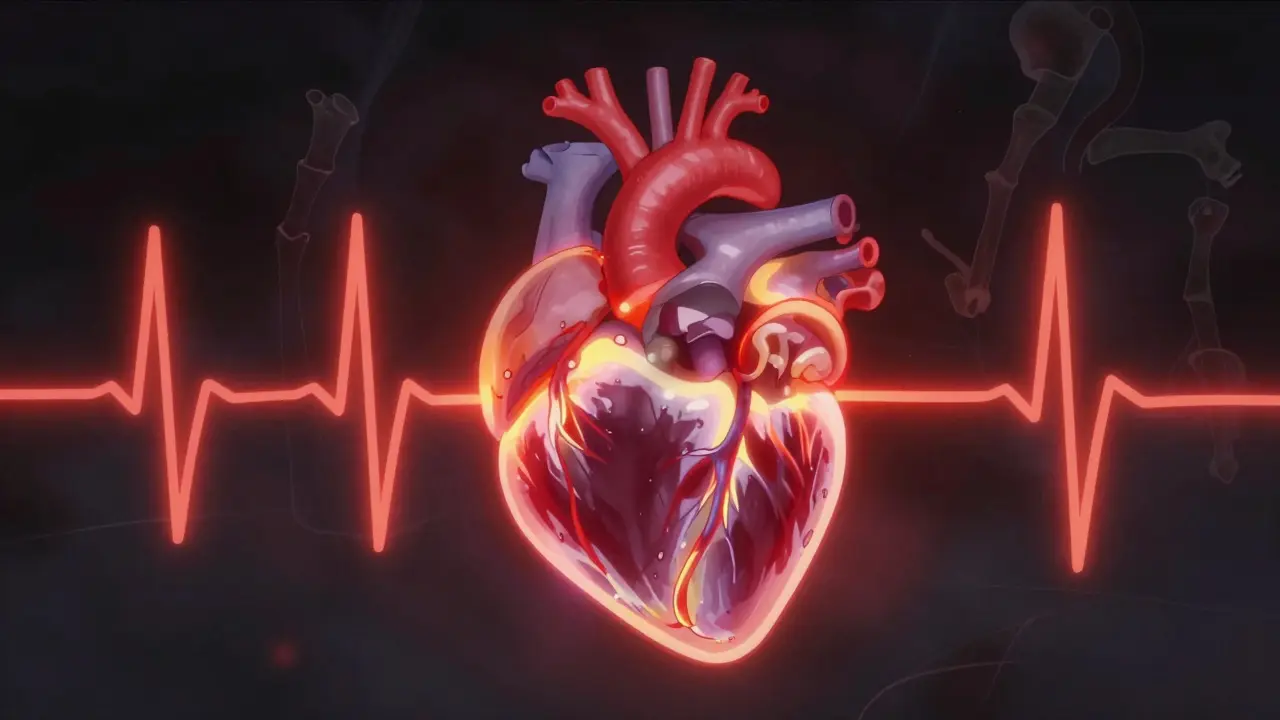
The most well-documented consequence of subclinical hyperthyroidism involves the cardiovascular system. Even without obvious symptoms, your heart is working harder than it should. A meta-analysis of five prospective cohort studies involving 8,711 participants, published in American Family Physician, highlighted a stark increase in the risk of atrial fibrillation (AFib). For patients with TSH levels below 0.1 mIU/L, the hazard ratio for developing AFib was 2.54. Those with TSH levels between 0.1 and 0.44 mIU/L still faced a significantly elevated risk, with a hazard ratio of 1.63.
Why does this happen? Thyroid hormones influence heart rate and contractility. When TSH is suppressed, the body experiences increased sympathetic tone and decreased vagal tone. This imbalance leads to several physiological changes:
- Increased average heart rate: Your resting pulse may be slightly higher, putting extra wear on the cardiac muscle.
- Left ventricular mass increase: The heart wall thickens as it works against higher metabolic demands.
- Diastolic dysfunction: The heart's ability to relax and fill with blood efficiently is compromised.
- Reduced heart rate variability: This indicates a loss of flexibility in how the heart responds to stress.
Heart failure is another major concern. A pooled analysis of six prospective cohort studies with over 25,000 participants found that TSH levels below 0.1 mIU/L were associated with a nearly doubled risk of heart failure compared to euthyroid (normal thyroid function) patients. Dr. Anne R. Cappola from the University of Pennsylvania emphasized in her research that the risk is most pronounced in those with severe TSH suppression, where the hazard ratio for heart failure reached 4.61 in specific elderly cohorts.
Bone Health and Cognitive Implications
While the heart takes center stage in discussions about subclinical hyperthyroidism, the skeletal system is also vulnerable. Thyroid hormones play a key role in bone remodeling. Excessive stimulation, even at subclinical levels, accelerates bone resorption faster than formation. Studies cited by the American Academy of Family Physicians show that patients with TSH levels below 0.1 mIU/L have a significantly increased risk of fractures. One study reported a hazard ratio of 2.3 for fractures compared to individuals with normal thyroid function. This is particularly concerning for postmenopausal women and older men who already face age-related bone density loss.
Cognitive effects are less robustly documented but still noteworthy. A 2016 study in the Journal of the American Geriatrics Society identified subtle declines in executive function among elderly patients with persistent subclinical hyperthyroidism. These changes might manifest as mild memory lapses or difficulty concentrating, often mistaken for normal aging. Quality of life metrics generally remain stable in mild cases, but they can decline in patients experiencing cardiac symptoms or severe TSH suppression.
Navigating Treatment Decisions
So, what do you do when the labs come back abnormal? The decision to treat is not one-size-fits-all. Current guidelines from the American Thyroid Association (ATA) and the American Academy of Family Physicians (AAFP) advocate for individualized management based on three pillars: TSH level, patient age, and cardiovascular risk profile.
For patients with TSH levels below 0.1 mIU/L, treatment is strongly recommended, especially for adults over 65 or those with preexisting heart disease, osteoporosis, or other cardiovascular risk factors. Dr. Jacqueline Jonklaas, lead author of the ATA guidelines, notes that clinical judgment is paramount in these cases. The goal is to prevent irreversible damage to the heart and bones.
If your TSH falls between 0.1 and 0.44 mIU/L, the approach is more conservative. Treatment is typically reserved for those who exhibit symptoms, have detectable cardiac abnormalities, or suffer from osteoporosis. For asymptomatic younger patients with mild suppression, watchful waiting with annual monitoring is often sufficient.
Treatment Options and Management Strategies
When treatment is deemed necessary, the strategy depends on the underlying cause. Subclinical hyperthyroidism can be endogenous (originating from the thyroid gland itself, such as in Graves' disease or toxic nodular goiter) or exogenous (caused by excessive thyroid hormone replacement therapy).
For exogenous causes, the solution is straightforward: adjust the dosage of levothyroxine or other thyroid medications under medical supervision. For endogenous causes, options include:
- Beta-blockers: Often used as first-line therapy to manage cardiac symptoms. They help reduce heart rate and improve left ventricular mass, though they do not correct the underlying thyroid issue.
- Radioactive iodine therapy: Commonly used for toxic nodular goiter or Graves' disease to ablate overactive thyroid tissue.
- Surgery: Thyroidectomy may be indicated in cases of large goiters causing compression or when radioactive iodine is contraindicated.
Dr. Kenneth D. Burman cautions against overtreatment, noting that creating iatrogenic hypothyroidism introduces its own set of cardiovascular risks. Therefore, the aim is to restore euthyroidism without swinging too far in the opposite direction. Monitoring frequency varies accordingly: every 3-6 months for high-risk patients with TSH <0.1 mIU/L, and annually for lower-risk individuals.
Future Directions and Ongoing Research
The landscape of subclinical hyperthyroidism management is evolving. The DEPOSIT study (Determining the Effect of Subclinical Hyperthyroidism on Prognosis in Older Thyroid Patients), tracking 5,000 patients across 15 European centers, aims to provide clearer data on long-term cardiovascular outcomes. Preliminary results from similar trials, such as the THAMES trial led by Dr. Angela Leung at UCLA, are expected to refine current thresholds and guide future guidelines. As we move through 2026, clinicians are increasingly focusing on personalized medicine, weighing the benefits of early intervention against the risks of unnecessary treatment.
What is the difference between subclinical and overt hyperthyroidism?
In overt hyperthyroidism, both TSH is suppressed and free T4/T3 levels are elevated, leading to clear symptoms like weight loss and rapid heartbeat. In subclinical hyperthyroidism, TSH is low, but free T4 and T3 levels remain within the normal reference range, often resulting in few or no noticeable symptoms.
At what TSH level should I be concerned about heart risks?
The highest risk for cardiovascular complications, such as atrial fibrillation and heart failure, occurs when TSH levels drop below 0.1 mIU/L. However, even mild suppression between 0.1 and 0.44 mIU/L carries an elevated risk, particularly in older adults or those with existing heart conditions.
Do I always need treatment for subclinical hyperthyroidism?
Not always. Treatment decisions depend on your age, TSH level, and overall health. Patients over 65 with TSH below 0.1 mIU/L are usually treated. Younger patients with mild suppression and no symptoms may only require regular monitoring rather than immediate intervention.
How does subclinical hyperthyroidism affect bone health?
Suppressed TSH levels accelerate bone turnover, leading to faster bone loss than formation. This increases the risk of osteoporosis and fractures, especially in postmenopausal women and elderly men. The risk is significantly higher when TSH is below 0.1 mIU/L.
What are the common causes of subclinical hyperthyroidism?
Common causes include endogenous issues like Graves' disease, toxic multinodular goiter, or toxic adenoma. Exogenous causes involve taking too much thyroid hormone medication, such as levothyroxine, for hypothyroidism treatment.
How often should I get my thyroid levels checked if I have this condition?
If your TSH is below 0.1 mIU/L or you have risk factors, testing is recommended every 3-6 months. For those with TSH between 0.1 and 0.44 mIU/L and no significant risk factors, annual monitoring is typically sufficient.