
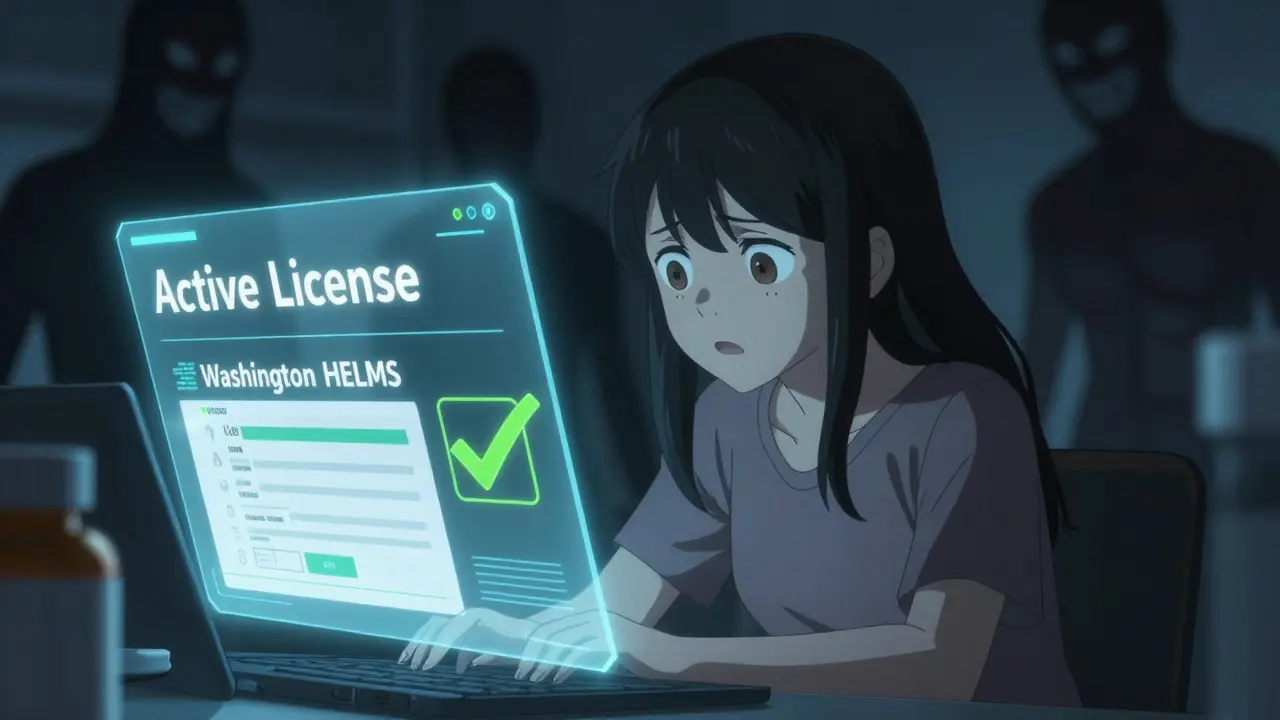
When you buy medication online, you're trusting that the pharmacy is legal, safe, and licensed. But not all online pharmacies are legitimate. Some sell fake, expired, or dangerous drugs. That’s why checking a pharmacy’s license isn’t optional-it’s a matter of safety. In 2022, the FDA identified over 1,200 illegal online pharmacies that could have put millions at risk. The good news? You can verify a pharmacy’s license in minutes. Here’s how.
Why Pharmacy Verification Matters
Counterfeit drugs are a real threat. Pills that look like Viagra or Adderall might contain rat poison, chalk, or no active ingredient at all. In 2023, a Chicago hospital hired a pharmacist whose Illinois license had been revoked-because they only checked their internal records, not the state database. The result? A $250,000 settlement after a patient suffered serious side effects.
The problem isn’t just rogue pharmacies. Even legitimate-looking sites can operate without proper licenses. That’s why state boards and national organizations built verification systems. These tools let you confirm whether a pharmacy is licensed, in good standing, and legally allowed to dispense prescriptions.
How Verification Systems Work
Most U.S. states now have online portals where you can search for licensed pharmacies. These systems are free, public, and run by state boards of pharmacy. They store data like:
- Pharmacy name and address
- License number and issue date
- Current status (active, suspended, expired)
- Disciplinary actions or violations
As of 2024, 48 out of 50 states maintain these systems. Washington State’s HELMS platform, launched in 2018, is one of the most user-friendly. It processes searches in under 3 seconds and shows clear details about disciplinary history. But not all systems are equal. Some require exact business names. Others don’t update immediately after renewals. And 18 states still don’t share data with national systems.
State vs. National Verification: What’s the Difference?
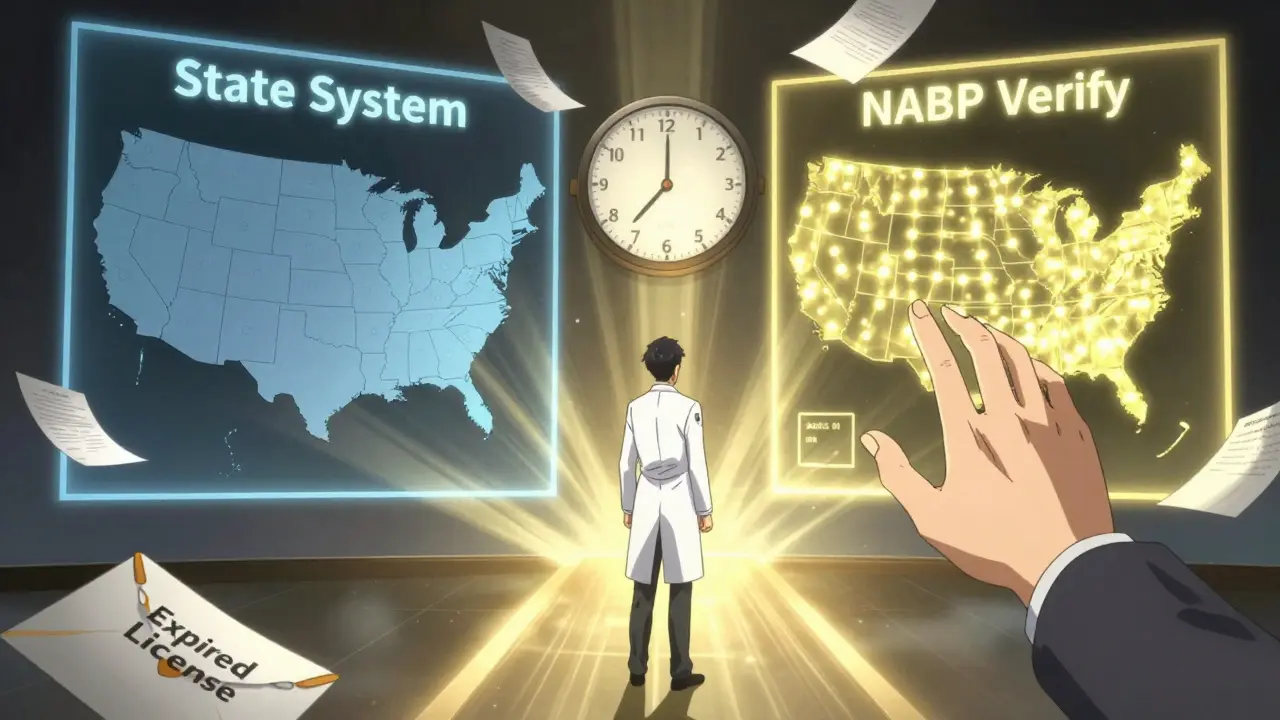
You have two main options: check a single state’s system or use a national service.
State systems (like Washington’s HELMS or Kentucky’s gateway.pharmacy.ky.gov) are free. But they only cover one state. If a pharmacy operates in multiple states, you have to check each one separately. That’s time-consuming. A pharmacist licensed in five states could spend over 20 minutes verifying each license individually.
NABP Verify, run by the National Association of Boards of Pharmacy, is the national solution. It checks licensure across 41 states in real time. It’s faster-averaging 3.2 minutes instead of 47. But it costs $79 per year. That’s affordable for hospitals and pharmacies, but a barrier for individual users.
Here’s how they compare:
| Feature | State System (e.g., Washington HELMS) | NABP Verify |
|---|---|---|
| Cost | Free | $79/year |
| Coverage | One state only | 41 states + territories |
| Update Speed | 24-72 hours | Real-time |
| Search Flexibility | Often requires exact name or license number | Search by name, address, license number |
| Best For | Local pharmacies, single-state operations | Multi-state pharmacies, hospitals, telehealth providers |
The FDA recommends NABP Verify for healthcare organizations because of its real-time monitoring. But for most consumers, checking one state’s system is enough-if you’re buying from a pharmacy based in your state.
How to Verify a Pharmacy License: Step-by-Step
Let’s say you’re considering an online pharmacy. Here’s what to do:
- Find the pharmacy’s official name and location. Look for a physical address-not just a PO box. Legitimate pharmacies list their full business name and street address.
- Go to your state’s pharmacy board website. For Washington, visit doh.wa.gov. For other states, search “[Your State] pharmacy license verification.”
- Use the search tool. Enter the pharmacy’s name or license number. If you don’t know the license number, try the business name. Some systems, like Washington’s, require exact matches. If the search fails, try variations.
- Check the license status. Look for “Active” or “In Good Standing.” Avoid pharmacies listed as “Expired,” “Suspended,” or “Revoked.”
- Look for disciplinary history. Some systems show past violations. A history of selling without prescriptions is a red flag.
- Verify the website matches the license. The pharmacy’s website domain should match its legal business name. A site like “cheap-pills4u.com” with a license under “Seattle Health Pharmacy” is suspicious.
Pro tip: Always verify before you pay. Don’t rely on seals like “VIPPS” or “LegitScript” alone. These can be faked. The only sure way is through the state board’s official database.
What to Watch Out For
Even with verification, there are pitfalls:
- Delayed updates. A pharmacy may renew its license, but the system might not show the update for up to 72 hours. If you’re unsure, wait a few days or call the board.
- Missed jurisdictions. If a pharmacy ships to multiple states, verify in each one. A license in California doesn’t mean it’s legal in New York.
- Outdated info. Some state systems haven’t been updated since 2019. The FDA warns that 2.3% of state verification records contain errors-enough to cause medication mistakes.
- Phony websites. Scammers copy legitimate sites. Always type the state board URL yourself. Don’t click links from emails or ads.
What’s Changing in 2025?
The system is getting better. Washington’s HELMS 2.0 upgrade, launching in late 2024, will cut search time to under 1.5 seconds and add API access for hospitals. The NABP is adding 14 more states to its real-time network by 2025, bringing total coverage to 55 jurisdictions.
Also, Epic Systems (used by 70% of U.S. hospitals) now links directly to 27 state boards in its 2024.3 software update. That means pharmacists can verify licenses inside their EHR-no extra logins needed. This cuts verification time by 82%.
Long-term, experts predict blockchain and biometric verification will replace today’s systems by 2028. Washington is already testing this with Amazon Web Services.
What If You Can’t Find the License?
If you search and can’t find the pharmacy, assume it’s not licensed. Walk away. No legitimate pharmacy hides its license. If you’re still unsure:
- Call your state board of pharmacy. Most have phone lines for public inquiries.
- Check the NABP’s list of verified pharmacies at nabp.pharmacy.
- Report suspicious sites to the FDA’s MedWatch program. They track illegal online pharmacies.
Buying medication online should be safe. You shouldn’t have to guess whether a pharmacy is legit. Verification services exist for one reason: to protect you. Use them.
Can I trust online pharmacies with VIPPS or LegitScript seals?
No, not alone. These seals are helpful, but they can be faked. The only way to be sure is to verify the pharmacy’s license directly through your state’s pharmacy board or NABP Verify. Always cross-check.
Do I need to verify a pharmacy if I’m using a big retailer like CVS or Walgreens online?
You still should. Even big names sometimes partner with third-party online pharmacies that aren’t properly licensed. Always confirm the actual pharmacy operating the site-its name and license number should be clearly listed on the checkout page.
Is it legal for an online pharmacy to ship prescriptions across state lines?
Yes, if the pharmacy is licensed in both the sending and receiving states. A pharmacy in Washington can ship to Oregon-but only if it holds valid licenses in both states. Always verify both.
How often do pharmacy licenses expire?
It varies by state. In Washington, licenses renew every two years, tied to the pharmacy owner’s birthday. In Kentucky, renewals are annual and due by June 30. Always check your state’s rules. A license that’s about to expire isn’t necessarily unsafe-but it’s a signal to double-check.
What should I do if I find a fake online pharmacy?
Report it immediately. Go to the FDA’s MedWatch portal at fda.gov/medwatch or call 1-800-FDA-1088. Also notify your state’s board of pharmacy. The more reports, the faster regulators can shut down illegal sites.
15 Responses
Just verified my go-to online pharmacy using Washington’s HELMS-license active, no red flags 😊
So glad I checked. Last month I almost ordered from a site that looked legit but had zero state records. Scary stuff.
Always double-check, even if it’s ‘just one time.’ Your health isn’t worth the gamble.
Also, love that they added API access-pharmacists will thank you later 🙌
Verification is non negotiable. Period.
i just typed in my pharmacy name and it said 'no results' so i called them and they said 'oh yeah we're licensed but the site is down' so i just trusted them lol 🤷♂️
NABP Verify costs $79? That’s a scam. My cousin runs a pharmacy and he says 90% of state systems are outdated anyway. If you’re not getting your meds from a big retailer, you’re already dead. Just sayin’.
Just got back from Nigeria and realized how lucky we are here.
Over there, people buy meds off WhatsApp sellers with no verification at all.
I saw a guy take a pill labeled 'VIGRA' with no expiration date-and he smiled like it was a lottery win.
Back home, we have state portals, real-time updates, even APIs.
It’s not perfect, but it’s lightyears ahead of most of the world.
Grateful for this system. And yeah, I still check every time. Always.
Small effort. Big protection.
Also, shoutout to Washington’s HELMS-clean UI, no ads, no BS. 🇳🇬❤️🇺🇸
I used to think this was overkill. Then my mom bought 'Adderall' from a site that looked like CVS. Turned out it was just caffeine and glitter. She ended up in ER for three days. Now I verify every single pharmacy. Even if it’s 'just' a refill. No exceptions.
UK doesn't have this. We rely on the GPhC register. Still better than nothing. Always check.
Oh honey, if you’re not verifying, you’re basically playing Russian roulette with your liver.
That ‘cheap-pills4u.com’ site? It’s probably run by a guy in a basement in Belarus who thinks 'pharmacy' means 'I own a printer.'
And don’t even get me started on those 'VIPPS' seals-those are just JPEGs copied from legit sites.
You think you’re saving money? You’re just funding a drug cartel with a Shopify store.
Go to your state board. Type it in. Hit enter. Five seconds. Your life is worth it.
And if you skip it? Don’t come crying to me when you start hallucinating because your 'Vicodin' was just chalk and regret.
For anyone new to this-don’t feel overwhelmed.
Start with one state. Pick your own. Search the name.
If you find it? You’ve done more than 90% of people.
It’s not about being perfect. It’s about being consistent.
I teach this to my nursing students every semester.
One student once said, 'I thought this was just bureaucracy.'
Then her uncle got sick from fake blood pressure meds.
Now she checks every pharmacy like it’s a ritual.
And honestly? So do I.
It’s not paranoia. It’s practice.
I verified my pharmacy and then I checked their domain against WHOIS and found they registered it 3 days ago under a PO box in Wyoming... so I called the state board and they said 'oh yeah that one got shut down last week'... I'm so glad I checked 😅
You got this. One minute. One search. One life saved. 💪
Just want to add something practical: if you’re using a telehealth service that prescribes meds, always ask them which pharmacy they use.
Many don’t tell you until checkout.
And if they say 'we use a partner pharmacy,' ask for the legal business name.
Then verify it.
I’ve seen cases where the pharmacy is licensed, but the prescriber isn’t.
Two separate checks. Both matter.
Also, if the site doesn’t list a physical address? Run.
Not walk. Run.
And if you’re unsure? Email your state board. They reply fast. Seriously.
They want you to be safe.
This isn’t red tape.
This is your safety net.
You know what’s wild?
People spend 20 minutes researching the best blender.
But hand them a $50 bottle of pills from a website they found on TikTok?
They click 'buy now' without blinking.
We live in a world where trust is currency-and scammers print fake bills.
Verification isn’t bureaucracy.
It’s the last firewall between you and a silent killer.
That pharmacy? It’s not just a website.
It’s the last person before the medicine hits your bloodstream.
And if you don’t check them?
You’re letting a stranger decide what goes into your body.
That’s not freedom.
That’s surrender.
Don’t surrender.
Verify.
This is all a psyop. The FDA is a front for Big Pharma. The 'state boards' are just corporate subsidiaries. You think they let you verify? They're monitoring your search history. The real pharmacy is the one you build in your basement with your own herbs and faith. The system is designed to make you dependent. Question everything.
I just replied to my own comment to say: I checked again today. Still active. Still clean. Still glad I did.