
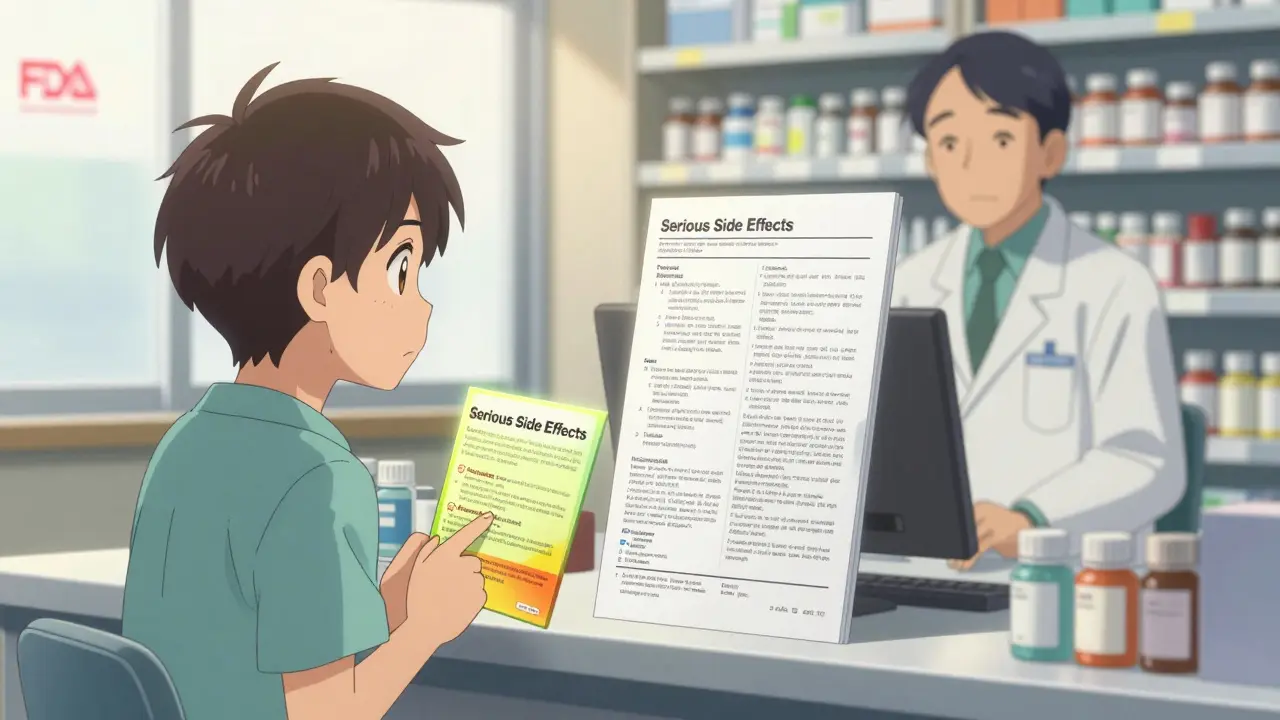
When you pick up a new prescription, you might get a small paper folded into the bag. Or maybe you don’t. You might wonder: where do I find real side effect details? Is it in that thin sheet the pharmacist handed you? Or is there a thicker, denser document your doctor has but never gave you? The answer isn’t simple-and it shouldn’t be. The U.S. Food and Drug Administration (FDA) requires two very different documents for the same drug: a Medication Guide and a Package Insert. They serve different people, say different things, and live in different places. Knowing which is which can help you understand your risks better-and even avoid serious harm.
What Is a Medication Guide?
A Medication Guide is a patient-friendly handout required by the FDA for certain prescription drugs. It’s not given out for every medication-only for those with serious risks that could affect your decision to take it. Think drugs like blood thinners (Xarelto), antidepressants with suicide risk warnings, or isotretinoin (Accutane), which can cause birth defects. Out of more than 20,000 prescription drugs in the U.S., only about 250 need one.
These guides are written to be easy to read. The FDA requires them to be at a 6th to 8th grade reading level. That means no medical jargon like "teratogenic" or "agranulocytosis." Instead, you’ll see clear headings like: "What is the most important information I should know?" and "What are the possible serious side effects?"
They’re designed to make you stop and think. For example, the Medication Guide for clozapine tells you exactly what symptoms to watch for-fever, sore throat, fatigue-because those could signal a life-threatening drop in white blood cells. One patient told the FDA that reading this guide saved her life. She recognized the warning signs and got help before it was too late.
But here’s the problem: pharmacies don’t always give them out. A 2018 FDA study found that only 37% of pharmacists consistently handed out required Medication Guides. Many patients don’t even know they exist. One Reddit user said they’d been on Xarelto for three years before they found the guide online. Your pharmacist is supposed to give you one the first time you fill the prescription-and every time the guide is updated. If they don’t, ask for it. It’s your right.
What Is a Package Insert?
The Package Insert-also called the Prescribing Information-is the full technical report on the drug. It’s written for doctors, pharmacists, and other healthcare professionals. It’s not meant for patients. It’s long-often 10 to 50 pages-and packed with data: clinical trial results, dosing recommendations, drug interactions, metabolism pathways, and every side effect ever reported in studies, even rare ones.
It’s organized into 23 specific sections under FDA rules. You’ll find "Boxed Warnings" (the most serious risks), "Adverse Reactions" (a long list of side effects ranked by frequency), "Drug Interactions," and "Use in Specific Populations" (like pregnant women or seniors). The language is dense. A 2019 study found the average Package Insert is written at a 12.7 grade level-way above what most people can easily understand.
That’s why most patients never see one. They’re not routinely given out at pharmacies. But they exist-and they contain the most complete side effect data available. If you want to know every possible side effect, even the ones that happen in 1 out of 1,000 people, this is where you look.
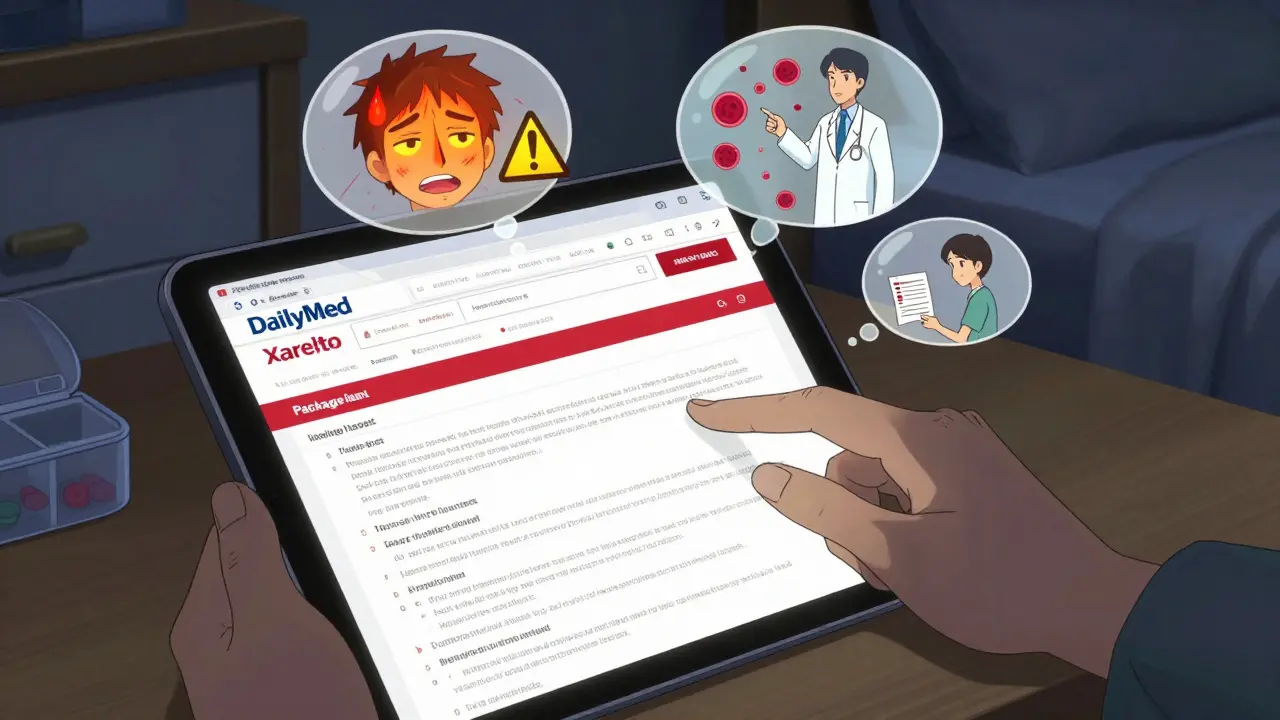
How do you get one? You can download it for free from DailyMed, a database run by the National Library of Medicine. Just search the drug name. You can also ask your pharmacist or check the drug manufacturer’s website. Some doctors print them out for patients, but that’s rare. Most people never think to ask.
Why Do Both Exist?
It’s not a mistake. It’s intentional design. The FDA created Medication Guides because they realized patients weren’t understanding the risks in the full Package Insert. Too many people were getting hurt because the information was too technical, too long, or simply never reached them.
So they split the job:
- Medication Guides tell you the top 3-5 risks you absolutely must know about-especially if you need to take action (like avoiding pregnancy, checking your blood, or calling your doctor right away).
- Package Inserts give doctors the full picture so they can make informed decisions about your treatment.
Think of it like a car manual. The owner’s manual tells you how to change a tire and what the warning lights mean. The service manual tells mechanics the torque specs for every bolt and the electrical schematics. You don’t need both to drive safely-but if something goes wrong, the mechanic needs the full manual.
One study found that when patients received and read Medication Guides for high-risk drugs, medication errors dropped by 22%. That’s a big deal. But it only works if you actually get the guide.
Where to Find Side Effect Details
If you want to know what side effects you might experience, here’s where to look-and what to expect from each source:
- At the pharmacy - Ask for the Medication Guide when you pick up your prescription. If they say they don’t have it, ask why. If it’s required by the FDA, they must give it to you. Don’t leave without it.
- FDA’s website - Go to the FDA’s Medication Guides page. It lists all 250+ guides alphabetically. You can search by drug name and download a PDF. This is the official, up-to-date version.
- Manufacturer websites - Most drug companies list Medication Guides on their product pages. Look for "Patient Information" or "Resources" sections.
- DailyMed - For the full side effect list, go to dailymed.nlm.nih.gov and search your drug. You’ll find the complete Package Insert. It’s technical, but you can copy-paste sections into a readability tool (like Hemingway App) to simplify it.
- Your doctor or pharmacist - If you’re confused, ask. Say: "Can you explain the side effects in plain language?" or "Is there a Medication Guide for this?"
Don’t rely on WebMD or Google searches alone. Those sites often pull from the Package Insert and may misinterpret the data. The FDA’s documents are the source. Everything else is a translation-or worse, speculation.
What’s Changing Soon
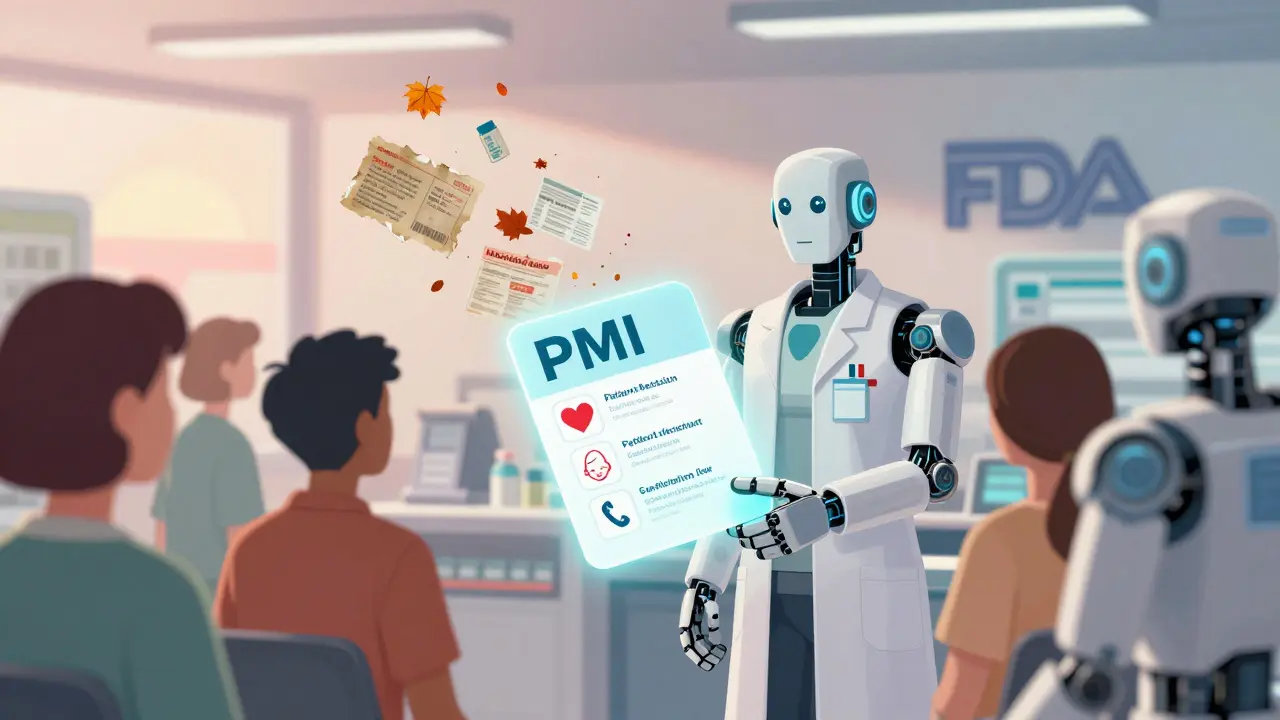
The FDA is getting ready to replace both systems with something new: the Patient Medication Information (PMI). Starting in 2026, every prescription drug will come with a single, standardized one-page handout-no more Medication Guides for some, nothing for others.
This new format will include:
- What the drug is for
- Most common side effects
- Serious side effects that need immediate action
- What to avoid (like alcohol or other drugs)
- When to call your doctor
It will be written at a 6th-grade level, printed on both sides of a single page, and required for every prescription. No exceptions.
Why? Because the current system is broken. Too many patients miss critical information. Too many pharmacists forget to hand out guides. Too many people rely on unreliable websites. The PMI aims to fix all that.
But until then-don’t wait. Know where to look now.
What to Do Today
Here’s a simple checklist to make sure you’re getting the right info:
- When you get a new prescription, ask: "Is there a Medication Guide for this?"
- If yes, take it. Read it. Keep it.
- If no, ask: "Why not? Is this drug on the FDA’s required list?"
- Go to DailyMed and search your drug. Download the Package Insert.
- Highlight the "Adverse Reactions" section. Look for side effects that happen in more than 1% of users-that’s your most likely risk list.
- Compare what’s in the Medication Guide to what’s in the Package Insert. The guide will focus on the top risks. The insert will have everything.
- If you’re unsure what anything means, call your pharmacist. They’re paid to explain this stuff.
You don’t need to be a doctor to understand your medication. But you do need to know where to find the facts-and who to ask when you don’t get them.
Do all prescription drugs come with a Medication Guide?
No. Only about 250 out of 20,000+ prescription drugs in the U.S. require a Medication Guide. These are drugs with serious risks that patients need to understand before taking them-like those that can cause birth defects, life-threatening blood disorders, or suicidal thoughts. Most common medications, like antibiotics or blood pressure pills, don’t need one.
Can I get a Package Insert from my pharmacy?
Pharmacies don’t routinely give out Package Inserts-they’re meant for healthcare providers. But you can ask for one. Most pharmacies can print it for you from a database or direct you to DailyMed, where you can download it for free. Don’t be shy about asking. You have the right to access your medication’s full information.
Why do Medication Guides only list some side effects?
Medication Guides focus only on the most serious or common side effects that require your action-like when to call your doctor or avoid pregnancy. They leave out rare or less serious side effects to avoid overwhelming you. The full list-including rare reactions-is in the Package Insert. The guide is meant to help you act, not to list every possible reaction.
What if my pharmacist never gave me a Medication Guide?
If your drug requires a Medication Guide, the pharmacy is legally required to give it to you the first time you fill the prescription-and every time the guide is updated. If they didn’t, ask why. If they say they don’t have it, call the FDA or check the FDA’s website to confirm if the drug requires one. You can download it yourself and bring it to your next visit.
Is the FDA replacing Medication Guides?
Yes. Starting in 2026, the FDA will roll out a new system called Patient Medication Information (PMI). Every prescription drug will come with a single, standardized one-page handout written in plain language. This will replace both Medication Guides and Patient Package Inserts. The goal is to make side effect information consistent, clear, and available to everyone-not just those on high-risk drugs.
12 Responses
Honestly, I didn’t even know Medication Guides were a thing until my mom got on warfarin. She showed me hers and I was like… wait, this whole time I thought the tiny pamphlet was just a receipt? That’s wild. I’ve been on antidepressants for years and never asked. Guess I’m lucky I didn’t miss anything serious.
so like… the fda just decided to make stuff easier to read? lol. i mean, if you cant handle 12th grade reading, maybe dont take meds? just sayin. also why do they even make these? people are dumb. its not the doc’s fault.
Okay so let me get this straight-pharmacies are supposed to give you these guides but they don’t? And the FDA knows this? And they’re still letting this happen? This isn’t negligence, this is a fucking crime. I’m not even mad, I’m just disappointed. Like, we’re paying for this system and they can’t even hand out a piece of paper? I’m not surprised though, healthcare in this country is a joke.
Bro I just found out about DailyMed last month and it changed everything. I used to just Google side effects and panic over every tiny thing. Now I go straight to the insert, copy the Adverse Reactions section into Hemingway, and boom-plain English. I even printed mine out and taped it to my pill organizer. My pharmacist thought I was weird but then asked if she could use the template for other patients. Small wins, y’know?
It is imperative to note that the regulatory framework governing pharmaceutical documentation is not merely bureaucratic redundancy, but rather a carefully calibrated mechanism to balance patient autonomy with clinical precision. The dichotomy between the Medication Guide and the Package Insert reflects a foundational epistemological distinction in medical communication: one intended for lay comprehension, the other for professional decision-making. To conflate the two is to misunderstand the architecture of informed consent.
I appreciate this breakdown. I’ve had patients ask me about side effects and I always direct them to DailyMed, but I never realized how few people even know it exists. I’ve started printing out the Package Insert for my older patients, highlighting the 1%+ reactions in yellow. They say it helps them feel less scared. Maybe we should all be doing that more often.
Wait… so you’re saying… the FDA… actually… cares… about… patients…?!!? I’m not crying, you’re crying. This is the most beautiful thing I’ve read all year. I’ve been on Xarelto for 5 years and never got a guide. I just assumed it was my fault for not asking. Now I feel like I’ve been gaslit by the healthcare system. I’m going to send this to my entire family.
This is all part of the Great Pharmaceutical Deception. The FDA, Big Pharma, and the medical-industrial complex are working in tandem to control your mind through language. The Medication Guide is a placebo for the masses-dumbed down so you won’t question the real dangers. The Package Insert? That’s the truth. But they don’t want you to see it. They want you dependent. The PMI? It’s just the next step-making you think you’re being helped while they strip away your right to know everything. Wake up.
Canada’s been doing this right for decades. We have standardized patient leaflets in every box-clear, concise, no fluff. The U.S. is still stuck in the Stone Age. Why are we letting this happen? Why do we tolerate incompetence? I’m embarrassed for my country.
Let’s be candid: the failure to distribute Medication Guides is a direct manifestation of systemic medical malfeasance. The pharmacological apparatus has become a profit-driven engine that prioritizes compliance metrics over human preservation. The absence of these guides constitutes a breach of the duty of non-maleficence, and the normalization of this lapse reveals a pathological indifference to patient agency. This is not negligence-it is institutionalized harm.
It’s funny… I used to think the Medication Guide was just fluff… until I read the one for my thyroid med… and realized it mentioned a rare but deadly reaction I’d been ignoring for months… I went to the ER that night… turned out I was developing Stevens-Johnson… they saved me… that guide… saved me… I still have it… in my wallet…
My grandma in India got her first American prescription last year-she didn’t speak English. I printed out the Medication Guide, used Google Translate, and we read it together. She didn’t understand all the words, but she understood: ‘Call if you feel dizzy or your skin turns yellow.’ That’s all she needed. This isn’t about reading level. It’s about care. And honestly? That’s what’s missing more than anything.