
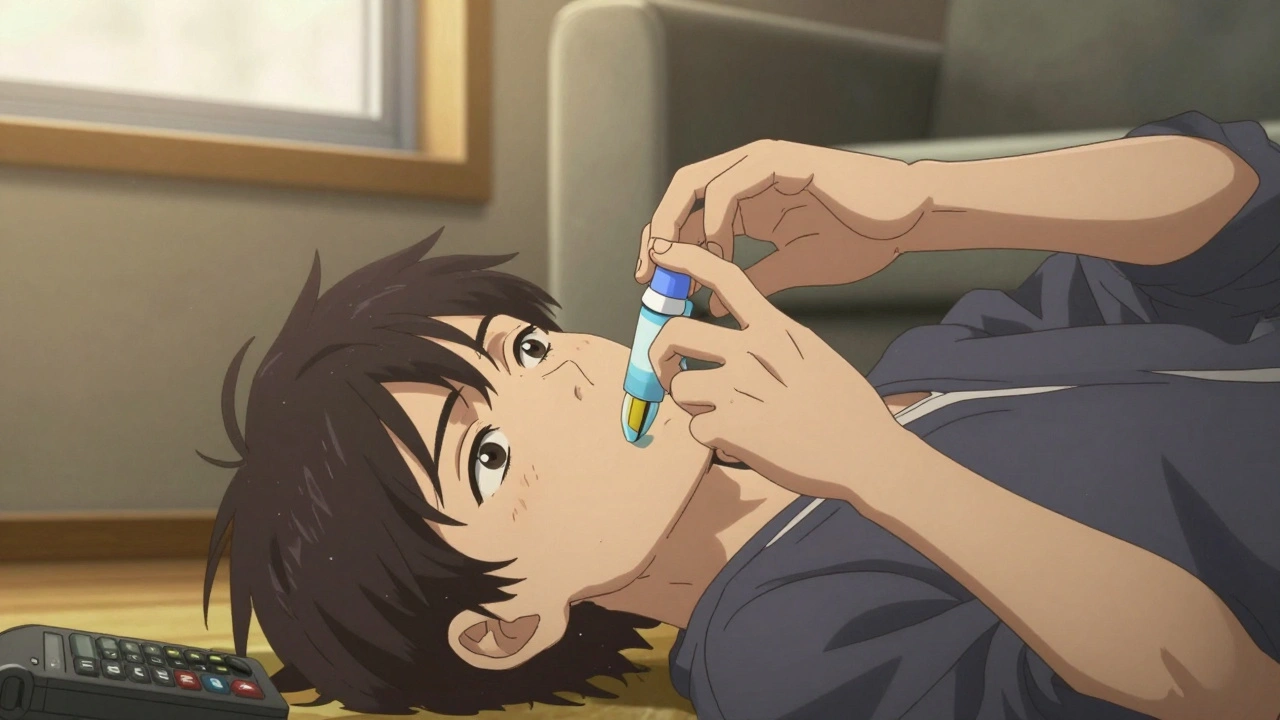
Every year, over 80,000 people in the U.S. die from opioid overdoses. Most of these deaths happen because someone doesn’t get help fast enough. But there’s a simple, life-saving tool that can reverse an overdose in minutes: naloxone nasal spray. It’s not magic. It’s medicine. And now, you can buy it without a prescription at pharmacies like CVS, Walgreens, and even online. You don’t need to be a doctor to use it. You just need to know how.
What Naloxone Does - And What It Doesn’t
Naloxone nasal spray works by kicking opioids off the brain’s receptors. When someone overdoses, opioids slow or stop their breathing. Naloxone doesn’t cure addiction. It doesn’t work on alcohol, benzodiazepines, or cocaine. But if opioids are in the system - whether it’s heroin, oxycodone, or deadly fentanyl - naloxone can bring someone back to life.
It’s fast. Most people start breathing again within 2 to 3 minutes. But it doesn’t last long. Naloxone wears off in 30 to 90 minutes. Many opioids, especially fentanyl, stick around much longer. That’s why you might need to give a second dose - or even a third.
Recognizing an Opioid Overdose
You can’t wait for someone to stop breathing completely. By then, it’s too late. Look for these signs:
- Slow, shallow, or no breathing (fewer than 12 breaths per minute)
- Unresponsive to shouting or a sternum rub (press knuckles hard into the center of the chest for 5-10 seconds)
- Pinpoint pupils - tiny dots in the center of the eyes
- Blue or gray lips and fingertips
- Limp body, snoring or gurgling sounds
If you see even one of these, assume it’s an opioid overdose. Don’t wait for all of them. Don’t wait to confirm. Give naloxone anyway. It’s safe. Even if they didn’t take opioids, it won’t hurt them.
Step-by-Step: How to Use Naloxone Nasal Spray
Here’s exactly what to do - in order. No guesswork. No delays.
- Call 911 immediately. This is non-negotiable. Even if you give naloxone, they still need emergency care. Tell the dispatcher you’re giving naloxone for a suspected opioid overdose. They’ll guide you while help is on the way.
- Position the person on their back. Tilt their head back slightly to open the airway. This helps them breathe better after naloxone kicks in.
- Remove the spray from its packaging. Don’t press the plunger yet. Some people accidentally trigger it while pulling it out. Keep it pointed away from you and others.
- Insert the nozzle into one nostril. Gently slide it in until your fingers touch the bottom of their nose. You’re aiming for about half an inch to one inch. Don’t force it.
- Press the plunger all the way down. This delivers the full 4 mg dose. You should hear a click. Hold it down for a full second. Don’t stop halfway. Studies show 18% of people don’t press far enough.
- Remove the spray. Don’t reuse it. Throw it away. It’s single-use.
- Wait 2-3 minutes. Watch for signs of breathing. Are their lips turning pink? Are they moving? If they start breathing normally, put them in the recovery position: on their side, one leg bent, head tilted back to keep the airway open.
- If no response after 3 minutes, give a second dose. Use a new spray. Put it in the other nostril. Don’t wait. Fentanyl overdoses often need two or more doses. The CDC says 32% of fentanyl cases require multiple doses.
- Stay with them. Monitor for at least 4 hours. Even if they wake up, the opioids could come back. They might slip back into overdose. Don’t let them walk around or go to sleep. Keep them awake and talking until EMS arrives.

What to Do If Naloxone Doesn’t Work
It’s rare, but sometimes naloxone doesn’t fully reverse an overdose. That doesn’t mean you did something wrong. It means the opioid was too strong.
Continue giving doses every 2-3 minutes if needed. Use as many sprays as you have. Don’t stop. At the same time, start rescue breathing if they’re not breathing on their own. Put your mouth over theirs, pinch their nose, and give one breath every 5 seconds. Keep going until they breathe on their own or help arrives.
Some people need IV naloxone from paramedics. That’s why calling 911 is critical. Even if you give three doses and they’re still not responding, keep breathing for them. You’re buying time.
Common Mistakes and How to Avoid Them
Most failures aren’t because naloxone doesn’t work. They’re because people don’t use it right.
- Mistake: Waiting to see if they wake up before acting. Solution: Act fast. Every minute counts.
- Mistake: Only giving one dose. Solution: Always have at least two sprays on hand. Fentanyl is powerful.
- Mistake: Not calling 911. Solution: Call before you give the spray. Paramedics can give more help.
- Mistake: Assuming naloxone works on all drugs. Solution: It only works on opioids. If someone took Xanax and heroin together, naloxone will help with the heroin part - but they still need medical care.
- Mistake: Not practicing. Solution: Get a trainer spray (often free from health departments) and practice on a friend. It takes 15 minutes. You’ll feel confident when it matters.

Where to Get Naloxone and How Much It Costs
You can buy NARCAN Nasal Spray (4 mg) at any pharmacy in the U.S. without a prescription. It usually comes in a two-pack. Price varies: $140-$180 without insurance. But many places give it away for free.
Check with your local health department, needle exchange programs, or community centers. Over 12,000 organizations nationwide offer free naloxone kits. The CDC and SAMHSA also have directories online. Some pharmacies offer discounts with coupons. If you have Medicaid or Medicare, it’s often covered.
There are stronger versions now - like Kloxxado (8 mg) - designed for potent opioids. But the standard 4 mg spray works for most cases. If you’re in an area with high fentanyl use, keep two 4 mg sprays on hand. It’s cheaper and easier to find than the 8 mg version.
Why This Matters - Real Stories
In September 2023, a man in Ohio saved his brother using two doses of NARCAN. He gave the first at 8:17 p.m. The second at 8:20 p.m. His brother started breathing again at 8:23 p.m. EMS arrived at 8:28 p.m. He’s alive today because someone knew what to do.
On the flip side, a user on Reddit said they gave three doses of naloxone to someone overdosing on fentanyl - and it didn’t work fully. The person needed IV naloxone from paramedics. That’s why you never stop there. Keep giving doses. Keep breathing for them. Keep calling for help.
These aren’t rare stories. They happen every day. In 2022, naloxone saved an estimated 27,000 lives in the U.S. That number could be 30,000 - or more - if everyone had access and knew how to use it.
Final Reminder: You Can’t Do Too Much
Naloxone is safe. It doesn’t cause addiction. It doesn’t harm people who didn’t take opioids. Giving too much won’t hurt them. Waiting too long might kill them.
If you see someone unresponsive, not breathing, with blue lips - give naloxone. Call 911. Start rescue breathing if needed. Keep going until help arrives. You’re not a hero. You’re just someone who acted.
Keep a spray in your car. In your bag. In your home. With your partner. With your kids’ friends. You never know when you’ll need it. And you’ll never regret having it.
12 Responses
Naloxone is just another tool the state gives you so you don’t have to think about why people are overdosing in the first place
They don’t want to fix poverty or trauma
They want you to carry a spray and feel good about yourself while the system keeps crushing people
It’s not救人
It’s distraction
One must consider the ontological implications of pharmacological intervention in the context of systemic societal collapse
The administration of naloxone is not merely a medical act but a metaphysical assertion of the will to preserve life against the entropy of modern alienation
Yet we must ask
Is the restoration of breath merely the prolongation of suffering
Or is it the first gasp of redemption
One spray does not a revolution make
But it does make a moment
I work in harm reduction and I can tell you this guide is spot on
People think naloxone is a cure
It’s not
It’s a bridge
And if you’re reading this you might be the one holding that bridge for someone who’s about to fall
Keep sprays in your car
Teach your kids
Don’t wait until it’s too late
You’re not a hero
You’re just human
It is imperative to note that the efficacy of naloxone administration is contingent upon prompt intervention and adherence to standardized protocols
Failure to initiate rescue breathing concurrently with naloxone delivery significantly diminishes survival probability
Furthermore
The notion that naloxone is universally accessible is misleading
Pharmaceutical pricing remains a structural barrier in rural and low-income communities
Policy must evolve beyond distribution to affordability
My uncle OD’d last year
We had the spray
Used it
He woke up
He’s sober now
Thanks to this
Why are we giving free narcan to drug addicts but not to veterans who need pain meds
Someone’s got a hidden agenda here
This is how they normalize addiction
They want you dependent
So you’ll vote for them
Wake up
This is the kind of practical compassion the world needs more of
Not just knowledge
But courage to act
It’s easy to scroll past
Harder to hold someone’s hand while they’re dying
But you did the hard thing
And you made it possible for others to do it too
Thank you
I used to be the person who looked away
Then I saw a girl in a parking lot turn blue
My friend had the spray
We didn’t know what we were doing
But we did it anyway
She woke up screaming
And then she cried
And then she hugged us
That day I stopped judging
And started carrying
Now I keep two in my purse
One for me
One for whoever needs it
It is a profound and troubling paradox that, in a nation that prides itself on individual liberty, we have been forced to rely on the spontaneous, untrained, and often terrified actions of bystanders to prevent mass mortality from pharmaceutical overreach - a crisis engineered, in part, by the very institutions that now peddle antidotes as if they were Band-Aids for a bullet wound
And yet
Still we are told to carry the spray
As if the solution to corporate greed
And regulatory failure
And the collapse of mental health infrastructure
Is a plastic nozzle and a single click
But perhaps
That click
Is the only thing standing between a mother and a grave
So we click
And we keep clicking
I think what’s beautiful here is how simple it is
No magic
No miracle
Just a person who didn’t look away
And a little spray
It doesn’t fix the system
But it says
You matter
Even now
Even like this
And that
Is enough
Did you know the government puts fentanyl in the water supply to keep people docile
That’s why they want you to carry naloxone
So you think you’re saving lives
But you’re just helping them survive the poison
They don’t want you to stop using
They want you to need it
And keep buying it
It’s all connected
Big Pharma
Big Pharma
Big Pharma
While I commend the intent of this guide
It is deeply irresponsible to suggest that laypersons should administer life-saving pharmaceuticals without formal certification
Such actions
While well-intentioned
May lead to unintended consequences
And legal liability
And
Most importantly
They undermine the sanctity of professional medical practice
One should not become a paramedic because they saw a YouTube video
And
That
Is
Enough