

Specialty medications and injectables are changing how we treat chronic diseases-but they’re also breaking the bank. These drugs, used for conditions like cancer, multiple sclerosis, and rheumatoid arthritis, make up just 2% of all prescriptions but account for half of all pharmacy spending. In 2023, the U.S. spent over $200 billion on these drugs alone, and that number is projected to hit $350 billion by 2027. For employers, the average cost per employee is $34.50 per month. That’s not a small line item-it’s a financial pressure point that’s growing faster than wages or inflation.
Start with Formulary Management
One of the most effective ways to cut costs is by tightening your pharmacy benefit manager’s (PBM) formulary. This means deciding which drugs are covered and under what conditions. Not all specialty drugs are created equal. Some have cheaper, equally effective alternatives. Formulary management uses tools like prior authorization, step therapy, and quantity limits to steer patients toward the best value.For example, Excellus BlueCross BlueShield found that using a structured prior authorization process for GLP-1 weight loss drugs saved $13.64 per member per month compared to national PBM plans. That’s over $160 per year per person. The key? Clinical oversight. When pharmacists and clinicians review each request-not just automated systems-you prevent unnecessary prescriptions without blocking access. Employers who implemented this saw 87% satisfaction from members who still got the drugs they needed, just with better oversight.
Use Narrow Pharmacy Networks
Instead of letting patients use any specialty pharmacy, limit them to a small group of high-performing providers. This isn’t about restriction-it’s about leverage. When you contract with fewer pharmacies, you get better pricing. CarelonRx found that narrow networks reduce costs by 10-15% on average. Why? These pharmacies agree to lower rates because they get more volume. They also tend to offer better clinical support: home delivery, nurse coaching, refill reminders.Children’s Hospital Association tracked a network of 10 preferred specialty pharmacies that saved $1.3 billion over three years. That’s a 10% reduction on $13 billion in gross spending. The catch? You need to communicate clearly. Some patients resisted switching pharmacies at first. About 22% of employers saw a spike in call center volume during the transition. But after six months, satisfaction rose because patients got better service. The savings were real-and so were the outcomes.
Switch to Biosimilars When Possible
Biosimilars are the generic version of biologic drugs. They’re not copies-they’re highly similar, FDA-approved versions that work the same way. The difference? Price. Biosimilars cost about 50% less than their brand-name counterparts. Quantum Health estimates that if biosimilars were adopted widely, the U.S. could save $180 billion over five years.Yet adoption is still low. Only 30% of eligible patients use them. Why? Prescribers are hesitant. Patients don’t know the difference. Insurance doesn’t always make it easy. But hospitals that pushed biosimilar transitions saw 20-30% cost drops with no loss in effectiveness. The solution? Education. Provide doctors with data. Show them real-world outcomes. Let pharmacists lead the conversation. Make biosimilars the default unless there’s a clear clinical reason not to. The FDA has approved 42 biosimilars as of 2023. Most are ready to use now.
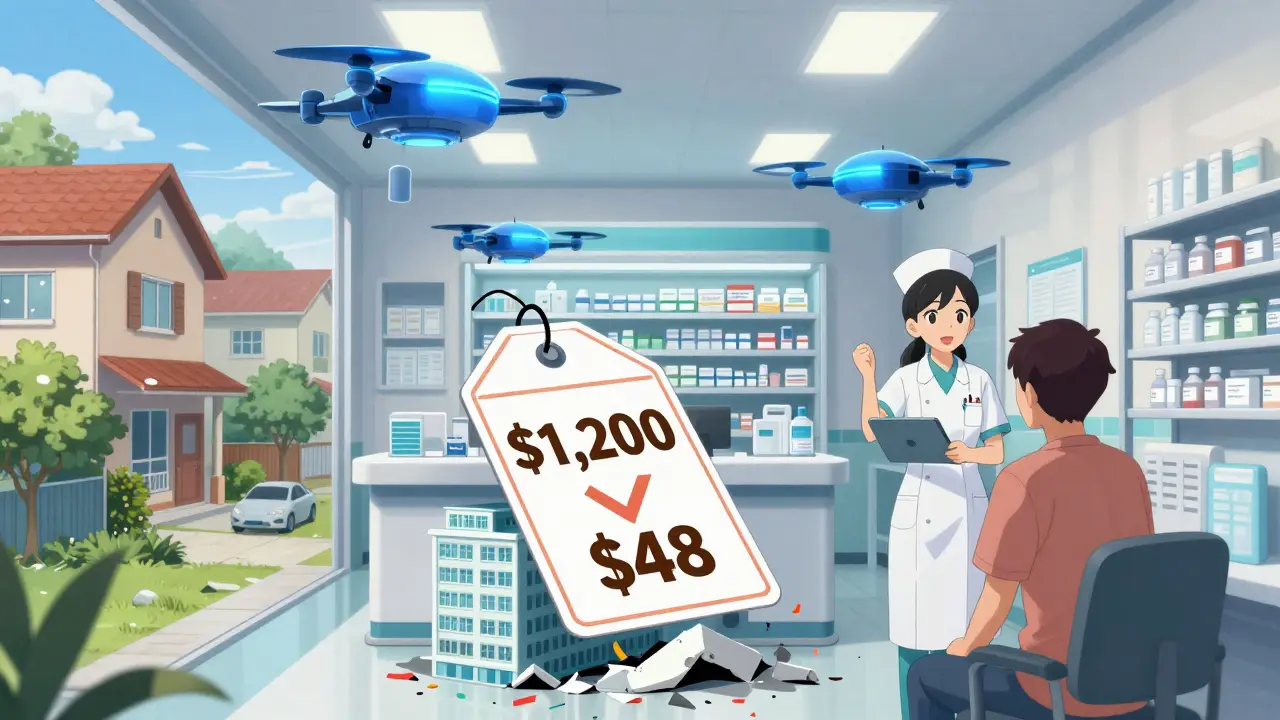
Move Infusions Out of Hospitals
Many injectables require infusion-slow delivery through an IV. Hospitals charge $500-$1,200 per session. A doctor’s office? $100-$200. Home infusion? Often less than $50. Quantum Health studied 220 specialty drugs and found that 91% of patients who received infusions in hospitals could have safely received them elsewhere. When they moved those patients, costs dropped by 48%.This isn’t theoretical. Prime Therapeutics saw 40-50% savings when patients switched from hospital outpatient departments to physician offices or home care. The trick? You need to coordinate care. Make sure the new site has trained staff, proper equipment, and emergency protocols. Offer transportation help if needed. Train patients on home administration if they’re eligible. For drugs like Enbrel or Humira, home infusion is safe, effective, and far cheaper. And patients prefer it-87% report higher satisfaction when they can receive treatment in their own home.
Maximize Rebates and Financial Assistance
Manufacturer rebates are hidden savings that most plans leave on the table. When a drug company offers a rebate to your PBM, it’s often not passed on to the plan sponsor. CarelonRx found that optimizing rebate structures can reduce net costs by 5-8% annually. That’s not a small win-it’s a game-changer for large employers.Also, use copay maximizer programs. These let patients use manufacturer coupons without counting toward their deductible. That means they pay $0 out-of-pocket, and the plan pays less. For example, a patient on a $1,500/month drug might have a $500 copay. A maximizer program lets them use a $1,000 coupon, so they pay nothing. The manufacturer covers the rest. The plan pays less than if the patient paid the full copay. This reduces financial burden on patients and lowers employer spend.
Combine Strategies for Maximum Impact
No single tactic does it all. Formulary management reduces inappropriate use. Narrow networks cut prices. Biosimilars slash costs. Treatment setting changes eliminate waste. Rebates and copay maximizers stretch every dollar further. Experts agree: the most successful programs use at least three of these together.Employers using four or more strategies cut specialty drug growth from 10-12% per year to just 5-7%. That’s a difference of $45-60 billion industry-wide by 2027. It’s not magic. It’s strategy. And it’s working right now.
What’s Holding You Back?
Some worry about access. Others fear backlash from patients or providers. But the data shows the opposite: when done right, these strategies improve care while lowering costs. Patients get better support. Clinicians get clearer guidelines. Employers get control over runaway spending.Start small. Pick one area. Maybe it’s switching your GLP-1 drugs to a narrow network. Or launching a biosimilar education campaign for your oncology patients. Track the results. Measure savings. Ask patients for feedback. Then expand.
The cost of doing nothing is higher than the cost of change. Specialty drugs aren’t going away. But how you manage them? That’s still in your hands.
Are biosimilars as safe as brand-name biologics?
Yes. Biosimilars are FDA-approved versions of biologic drugs that have no clinically meaningful differences in safety, purity, or potency. The FDA requires extensive testing before approval, including clinical trials. Studies show biosimilars work just as well as the original drugs-for example, infliximab biosimilars have the same effectiveness as Remicade in treating Crohn’s disease and rheumatoid arthritis. Over 42 biosimilars are approved in the U.S., and real-world use confirms their safety.
Can patients still get their preferred drug if it’s not on the formulary?
Yes, but with oversight. Most formularies include exceptions for clinical necessity. If a doctor proves that an alternative won’t work-due to allergies, prior failure, or medical history-the patient can still get the original drug. The prior authorization process isn’t a barrier; it’s a filter. It ensures that expensive drugs are used only when truly needed, not just because they’re familiar.
How long does it take to see savings from these strategies?
You’ll start seeing results within 3-6 months. Formulary changes and narrow networks often show savings in the first billing cycle. Biosimilar switches take longer-usually 6-12 months-as prescribers and patients adjust. Treatment setting shifts can cut costs immediately if patients are transitioned quickly. Most employers report a full return on investment within 12-18 months. The biggest savings compound over time as more patients move to lower-cost options.
Do these strategies affect patient adherence?
Actually, they often improve it. When patients use preferred pharmacies, they get more support: refill reminders, nurse consultations, delivery to their door. Studies show adherence increases by 12-15% in these programs. Patients aren’t forced into cheaper drugs-they’re guided toward better-managed care. The right support makes adherence easier, not harder.
Is home infusion safe for all injectable medications?
Not all, but many. About 63% of specialty injectables can be safely administered at home, according to Quantum Health. Drugs like interferons, monoclonal antibodies, and some immunoglobulins are routinely given at home with proper training. High-risk drugs-like those requiring complex monitoring or emergency backup-are still better suited for clinics. The key is matching the drug to the right setting, not just cutting costs. Clinical teams should review each drug individually to determine eligibility.
11 Responses
These drugs cost a fortune because they can. Pharma companies don't care about patients-they care about profit margins. A $10,000/month drug isn't expensive-it's a business model. And yeah, biosimilars work fine. We've been using them in Europe for years. No one dies. No one gets worse. Just cheaper.
Stop pretending this is about healthcare. It's about greed dressed up as innovation.
So… we’re just gonna quietly ignore that 87% of patients are *happy* with these cost-cutting moves? And yet somehow, the sky is falling? I mean, if you’re getting your drug delivered to your door with a nurse checking in on you… and you’re paying $0… why are you mad?
…I’m not mad. I’m just disappointed. In people who think ‘affordable’ means ‘unavailable’.
Yessss!! I love how this breaks it down so clearly 😊 I’ve been in HR for 8 years and this is the first time I’ve seen a real roadmap-not just ‘cut costs’ vibes. The home infusion thing? My cousin got her MS meds at home for $38/session. She cried. Not from pain-from relief.
Also, biosimilars? My dad’s on one. Same results. Half the price. He’s now saving $1,200/month. He bought a new guitar. 🎸
Let’s stop acting like savings = sacrifice. They’re not. They’re smart.
Wow. So the answer to ‘how do we stop spending a billion on drugs’ is… make patients jump through more hoops? Prior auth, narrow networks, ‘educate’ them into taking generics? Sounds like corporate yoga.
Meanwhile, the drug companies are laughing all the way to the bank. This isn’t fixing anything. It’s just moving the pain around.
There is a deeper truth here: healthcare is not a commodity. But it is also not a charity. The system we have now is unsustainable because it confuses compassion with cost-blindness. We must honor both the dignity of the patient and the responsibility of the payer.
These strategies are not about denying care. They are about aligning resources with outcomes. That is not cruel. It is wise. And it is long overdue.
Let’s be real: if a drug costs $15K/month and there’s a $7K alternative that works just as well, why are we even having this conversation?
It’s not about ‘access.’ It’s about inertia. Doctors prescribe what they know. Patients take what’s handed to them. PBMs don’t push savings because they get kickbacks from brand names.
Fix the incentives. Not the patients.
The 48% drop in infusion costs? That’s not a win-it’s a no-brainer. Hospitals charge like they’re running a luxury spa. Home infusion isn’t ‘alternative.’ It’s the default. Why are we still talking about this like it’s radical?
Also, biosimilars? The FDA doesn’t approve junk. If it’s on the market, it’s not a gamble. It’s science. Stop acting like generics are magic beans.
I appreciate the data. I truly do. But I worry about the human layer. What about the patient who doesn’t understand prior auth? Who can’t navigate a new pharmacy network? Who gets confused by ‘biosimilar’ and thinks they’re getting a ‘fake’ drug?
Strategy is great. But if we don’t accompany it with empathy, patience, and clear communication-we’re just automating exclusion.
It's fascinating how we've turned 'cost containment' into a moral crusade. The real issue isn't the drugs-it's the lack of transparency in pricing. We don't know what the drug actually costs to make. We don't know how much of the $15,000 is R&D, marketing, or executive bonuses.
Until we fix that, all these tactics are just rearranging deck chairs on the Titanic.
Let me be clear: if you're using a 'copay maximizer' program, you're not saving money-you're shifting it. The manufacturer pays the coupon, but the plan still pays the full price. You're not reducing cost-you're hiding it. And that's not smart. That's accounting theater.
This whole post reads like a PBM sales pitch dressed up as public service.
Bro. Biosimilars are the OG flex. Same drug. Half the price. No drama. I’ve seen people get their Humira for $400 instead of $800. They didn’t even notice. Just got their shot. Kept living. Saved a grand. That’s not a ‘strategy.’ That’s common sense.
Why are we still debating this? It’s like arguing over whether to use a $200 hammer or a $400 one that does the exact same thing.