
The U.S. Food and Drug Administration doesn’t wait for problems to happen before stepping in. Instead, it shows up - unannounced or with notice - at manufacturing sites across the globe to make sure what ends up in your medicine, medical device, or food is safe and works as it should. These FDA facility inspections aren’t just checks. They’re a core part of how the agency keeps millions of people safe every day.
Why FDA Inspections Even Exist
It all started in 1938 with the Federal Food, Drug, and Cosmetic Act. Before that, there were no real rules for how drugs or food were made. People got sick from contaminated products. The FDA was given power to step in, but it wasn’t until later amendments - like the 1962 Kefauver-Harris Amendments and the 2012 Food Safety Modernization Act - that inspections became systematic, risk-based, and tied directly to quality standards. Today, the FDA inspects about 12,000 U.S. facilities and 1,000 foreign ones each year. That’s not random. Every site is scored on risk: what kind of product is made, how often it’s had problems, and how complex the manufacturing process is. A factory making insulin for diabetics? High risk. One making over-the-counter pain relievers? Lower risk. The agency doesn’t waste time on low-risk sites when high-risk ones need attention.The Four Types of FDA Inspections
Not all inspections are the same. The FDA uses four clear types, each with a different purpose:- Pre-approval inspections happen before a new drug or device gets approved. The FDA wants to see that the facility can consistently make the product according to its approved design. If the inspection fails, the product won’t get cleared - no matter how promising the science.
- Routine surveillance inspections are the most common. These happen every 2 to 5 years, depending on risk. A high-risk facility might get visited every 6 to 12 months. A low-risk one might go 4 years without a visit.
- Compliance follow-up inspections return to sites that had problems before. The FDA checks if the fixes actually stuck. If not, penalties get worse.
- For-cause inspections are triggered by red flags: a spike in patient complaints, a whistleblower tip, or an unexpected death linked to a product. These can happen with zero notice.
What Happens During an Inspection
When the FDA arrives, they don’t just walk in. They hand you FDA Form 482 - the official Notice of Inspection. You’re required to have someone with you the whole time. No hiding. No delays. The inspection lasts 3 to 10 days. It’s not a tour. It’s a deep dive. Investigators look at:- Records: deviation logs, training files, equipment validation, process validation, and analytical method data
- Facility layout: is the clean room actually clean? Are there cross-contamination risks?
- Staff interviews: they ask the same question to five different people. If answers don’t match, that’s a red flag
- Sample collection: they might take a batch of pills or a device to test in their own lab
The Biggest Reasons Facilities Fail
Data from thousands of inspections shows the same mistakes keep happening. The top four causes of observations:- Inadequate deviation investigations (32%): When something goes wrong - a machine breaks, a batch fails - you don’t just fix it. You dig deep. Why did it happen? Could it happen again? Most companies just patch it and move on. The FDA wants root cause analysis.
- Incomplete training records (24%): Every person who touches the product needs documented training. Not just a signature on a sheet. They need proof they understood the procedure and can do it correctly.
- Insufficient validation documentation (15%): You can’t say, “We’ve been doing this for 10 years.” You need data showing your process consistently produces quality. For every step - mixing, filling, packaging - you need validation reports.
- Poor change control records (7%): If you change a supplier, a machine, or a cleaning procedure, you must document it, test it, and approve it. No exceptions.
How to Get Ready - Real Strategies That Work
You can’t wing it. Facilities with formal inspection readiness programs cut their observation rates by 63%. Here’s what actually works:- Assign one inspection coordinator. Not three. Not five. One person who owns the process. Facilities that did this saw smoother inspections and fewer delays.
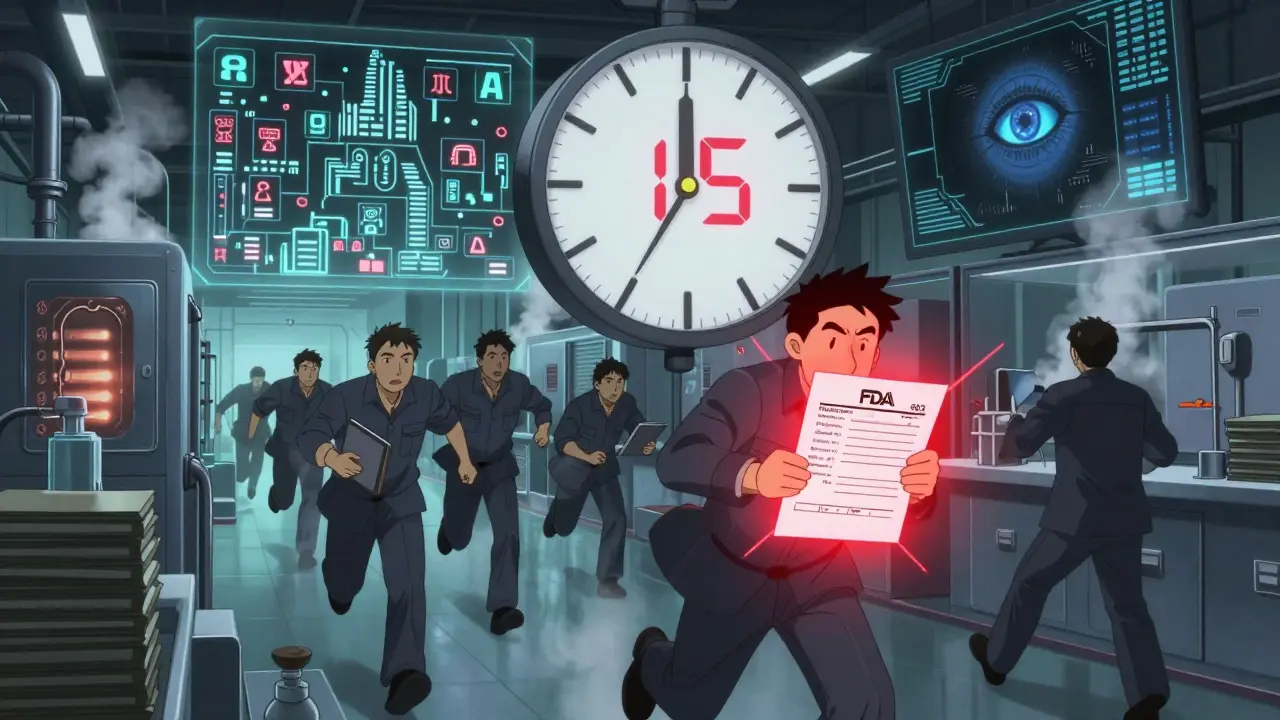
- Use a runner system. Have someone ready to grab documents the moment they’re requested. One company cut inspection time by 22% just by having a dedicated person running files to the inspection room.
- Update your facility diagram within 7 days of any change. If you move a machine, update the map. Inspectors compare your diagram to what they see. If it doesn’t match, they assume you’re hiding something.
- Run quarterly mock inspections. Bring in an outsider to simulate the real thing. Record everything. Find your weak spots before the FDA does.
- Train your staff. Everyone who might talk to an inspector needs 8 hours of training a year. Principal investigators need 16. Only 63% of sites meet this. Don’t be one of the 37%.
What’s Changing in 2025 and Beyond
The FDA isn’t standing still. In 2024, they started testing AI tools to scan documents faster. By Q3 2025, they’ll roll out AI-assisted review systems in pilot facilities. This means they’ll be able to spot inconsistencies in records faster - like mismatched dates, missing signatures, or altered entries. They’re also expanding remote inspections. In 2022 and 2023, they did virtual tours and document reviews with 147 facilities. For 78% of documentation checks, it worked just as well as being there in person. By 2026, they plan to increase remote tools by 35%. But here’s the real shift: inspection frequency is changing based on risk. High-risk products - especially those for older patients - will see more inspections. Dietary supplements? Fewer. The FDA is getting smarter about where to put its limited resources.What Happens After the Inspection
Getting a Form 483 isn’t the end. It’s the start of a conversation. Your response matters more than the findings. A strong response includes:- Each observation listed clearly
- A root cause analysis for each
- A timeline for correction
- Proof the fix will stick - like updated SOPs, retraining records, or validation data
Final Reality Check
FDA inspections aren’t about catching you out. They’re about making sure you’re doing the right thing every day. The companies that thrive aren’t the ones with perfect records. They’re the ones with honest systems, trained people, and a culture that doesn’t hide mistakes - they fix them. If you’re preparing for an inspection, stop worrying about impressing the inspector. Start worrying about making sure your processes are solid enough that you wouldn’t need an inspector at all. Because if your system works, the inspection just confirms it.How often does the FDA inspect manufacturing facilities?
The FDA inspects facilities based on risk. High-risk sites, like those making life-saving drugs or medical devices, may be inspected every 6 to 12 months. Lower-risk sites, such as those producing dietary supplements or over-the-counter products, typically go 3 to 5 years between inspections. The agency uses a risk-based model that considers product type, past violations, and manufacturing complexity.
What is FDA Form 483 and why does it matter?
FDA Form 483 is a written list of objectionable conditions found during an inspection. It’s not a fine or a shutdown order - it’s a notice that something needs to be fixed. Facilities must respond within 15 working days with a corrective action plan. If the response is inadequate or ignored, the FDA may issue a warning letter, which is public and can damage reputation and sales.
What are the most common reasons for FDA inspection failures?
The top four reasons are: inadequate investigation of deviations (32%), incomplete training records (24%), insufficient validation documentation (15%), and poor change control records (7%). Data integrity issues - like falsified electronic records - have risen sharply and now account for 45% of all observations.
Can the FDA inspect a facility without warning?
Yes. Routine inspections usually give 5 business days’ notice, but "for-cause" inspections - triggered by complaints, adverse events, or whistleblower tips - can happen with no advance notice. Facilities must be ready at all times to receive an inspector.
How can a company improve its chances of passing an FDA inspection?
Companies with formal inspection readiness programs reduce observation rates by 63%. Key steps include assigning one inspection coordinator, running quarterly mock inspections, updating facility diagrams within 7 days of any change, and ensuring all staff complete required training. Having a dedicated inspection room with quick access to documents can cut inspection time by 22%.
Are remote FDA inspections real?
Yes. Since 2022, the FDA has piloted remote inspections using virtual tours and digital document reviews. In 78% of cases, these were as effective as in-person visits for reviewing records. By 2026, the agency plans to increase remote tools by 35%, especially for documentation-heavy checks. However, physical inspections are still required for evaluating facility layout and equipment conditions.
What records must a facility keep after a product is discontinued?
Facilities must retain all records for at least 2 years after a product is discontinued. For certain products - like those with long-term safety monitoring requirements - records may need to be kept longer. In 2023, 87% of Form 483 observations involved records that were missing, incomplete, or expired beyond the required retention period.
What’s the difference between CGMP and QSR?
CGMP stands for Current Good Manufacturing Practice and applies to drugs and biologics. QSR, or Quality System Regulation, applies to medical devices. Both require documented processes, training, validation, and control of changes, but QSR focuses more on design controls, risk management, and usability testing, while CGMP emphasizes batch records, environmental controls, and sterility assurance.
9 Responses
I've seen too many companies treat Form 483 like a suggestion box. It's not. It's a countdown to a warning letter if you don't treat it like your business depends on it-because it does.
And data integrity? 45% of observations? That's not a trend. That's a systemic failure in culture. If your QA team is still using Excel sheets for batch records, you're already behind.
The root cause analysis deficit is staggering-32% of observations? That’s not incompetence; it’s institutionalized negligence. Companies invest in fancy HPLC machines but skimp on training personnel to interrogate deviations. You can’t validate a process if you don’t understand why it broke in the first place. The FDA isn’t asking for perfection-they’re asking for intellectual rigor. And that’s a muscle most facilities haven’t trained.
In India, many small pharma units still think FDA is just a paperwork game. They fix what’s listed on Form 483 but never fix the system. It’s like patching a leaky roof with duct tape. The rain always comes back.
Let’s be real-most of these inspections are performative theater. The FDA doesn’t have the manpower to do this right. They pick low-hanging fruit: training logs, outdated diagrams. Meanwhile, the real risks-like supply chain corruption or unvalidated software-are ignored because they’re too hard to audit. This is regulatory theater with a side of compliance theater.
It is of paramount importance to underscore that the maintenance of rigorous documentation protocols is not merely a regulatory obligation, but a moral imperative in the context of public health safety. The failure to adhere to established change control procedures constitutes an unconscionable breach of fiduciary duty to the consumer population.
So... we're paying millions so some guy in a suit can look at our spreadsheets? 🤡
In many Asian and African manufacturing hubs, the cultural perception of authority differs significantly from Western regulatory expectations. The concept of an unannounced inspection is often met with confusion rather than compliance. Building mutual understanding through pre-inspection cultural briefings could yield more sustainable outcomes than punitive measures alone.
Mock inspections are a game-changer. We started doing them quarterly last year. Our last real FDA visit? Zero observations. The inspectors actually complimented our runner system. Turns out, having someone ready to hand over a document in 10 seconds instead of 10 minutes makes a huge difference. People think it’s about paperwork. It’s about rhythm.
The notion that companies can ‘get ready’ for an FDA inspection is fundamentally flawed. True compliance is not a state of preparedness; it is an existential condition of operational integrity. To treat inspections as events to be managed-rather than as inevitable validations of a culture of quality-is to misunderstand the very purpose of CGMP and QSR. The 63% reduction in observations cited by proponents of ‘readiness programs’ is not evidence of success-it is evidence of gaming the system. The FDA does not inspect to reward preparation; it inspects to expose decay. If your facility requires a dedicated inspection coordinator, you have already failed. A properly functioning quality system requires no coordinator-it requires no exception. It requires discipline. It requires humility. And it requires the eradication of the myth that compliance can be outsourced to a checklist.