

Medication Adherence Calculator
How Digital Pills Improve Adherence
Digital pill sensors can dramatically improve medication adherence for chronic conditions. According to the article, adherence rates improved from 62% to 84% in a 12-week study with antipsychotic medication. This calculator helps you understand the real-world impact of this improvement.
Results
Imagine swallowing a pill and knowing, with certainty, that it actually reached your stomach - not just that you took it, but that your body started absorbing it. That’s not science fiction anymore. Digital pill sensors are turning this idea into reality, giving doctors and patients real-time data on whether medications are being taken and how the body is responding. For people managing chronic conditions like schizophrenia, HIV, or heart disease, this technology could mean the difference between stable health and a hospital visit.
How Digital Pills Actually Work
A digital pill isn’t just medicine. It’s a tiny electronic device hidden inside a capsule. The sensor is about the size of a grain of sand - 5 millimeters wide and less than half a millimeter thick. It’s made of silicon with copper and magnesium electrodes. When you swallow it, stomach acid triggers a simple chemical reaction: magnesium meets cuprous chloride. That tiny burst of energy - just 1 to 2 volts - powers the sensor long enough to send a signal. That signal gets picked up by a small patch you wear on your abdomen. It’s like a fitness tracker, but instead of counting steps, it’s watching for your pill. The patch uses Bluetooth Low Energy (BLE) to relay the data to your phone. From there, it goes to a secure server where your doctor or care team can see when you took your medication, down to the minute. Some systems go further. The IntelliCap from Philips Research can measure stomach pH and temperature in real time. Others are starting to detect biomarkers - chemicals in your gut that signal how your body is processing the drug. This isn’t just about whether you swallowed it. It’s about whether your body reacted the way it should.Why Medication Adherence Matters More Than You Think
Half of all people with chronic illnesses don’t take their meds as prescribed. That’s not laziness. It’s forgetfulness, side effects, cost, confusion, or just feeling fine and thinking they don’t need it anymore. The World Health Organization calls this the biggest problem in modern medicine. Digital pills fix that by removing guesswork. In one 12-week study with 157 people on antipsychotic medication, adherence jumped from 62% to 84% when they used a digital pill system. That’s not a small gain - it’s life-changing. For someone with schizophrenia, missing doses can lead to psychosis, ER visits, or even jail. For someone with HIV, it can lead to drug-resistant strains. For someone with heart failure, it can mean hospitalization. The data doesn’t lie. If your doctor sees you skipped your pill on Friday night, they can ask why. Maybe you were out with friends. Maybe you were afraid of side effects. Maybe you ran out and couldn’t afford a refill. With that insight, care becomes personal. It’s no longer, “Why didn’t you take your medicine?” It’s, “What happened Friday? How can we help?”Can These Pills Detect Side Effects?
Yes - and that’s where things get really interesting. The wearable patch doesn’t just receive signals from the pill. It also tracks your heart rate, movement, and activity levels. If your heart rate spikes unexpectedly after taking your pill, or if your steps drop sharply the next day, the system flags it. These aren’t direct diagnoses, but they’re strong indicators. A sudden drop in movement could mean dizziness from a blood pressure med. A spike in heart rate might signal an allergic reaction or a drug interaction. In 2023, the FDA approved the first digital pill for tuberculosis treatment. That’s a big deal. TB meds are brutal - nausea, liver damage, nerve pain. Doctors now have a way to see not just if patients take the pills, but if their bodies are struggling with them. Researchers are training AI models to predict side effects before they become severe. One system, developed by etectRx and IBM Watson Health, predicts adherence lapses with 82% accuracy by analyzing patterns in movement, sleep, and pill-taking behavior. This isn’t about surveillance. It’s about early warning.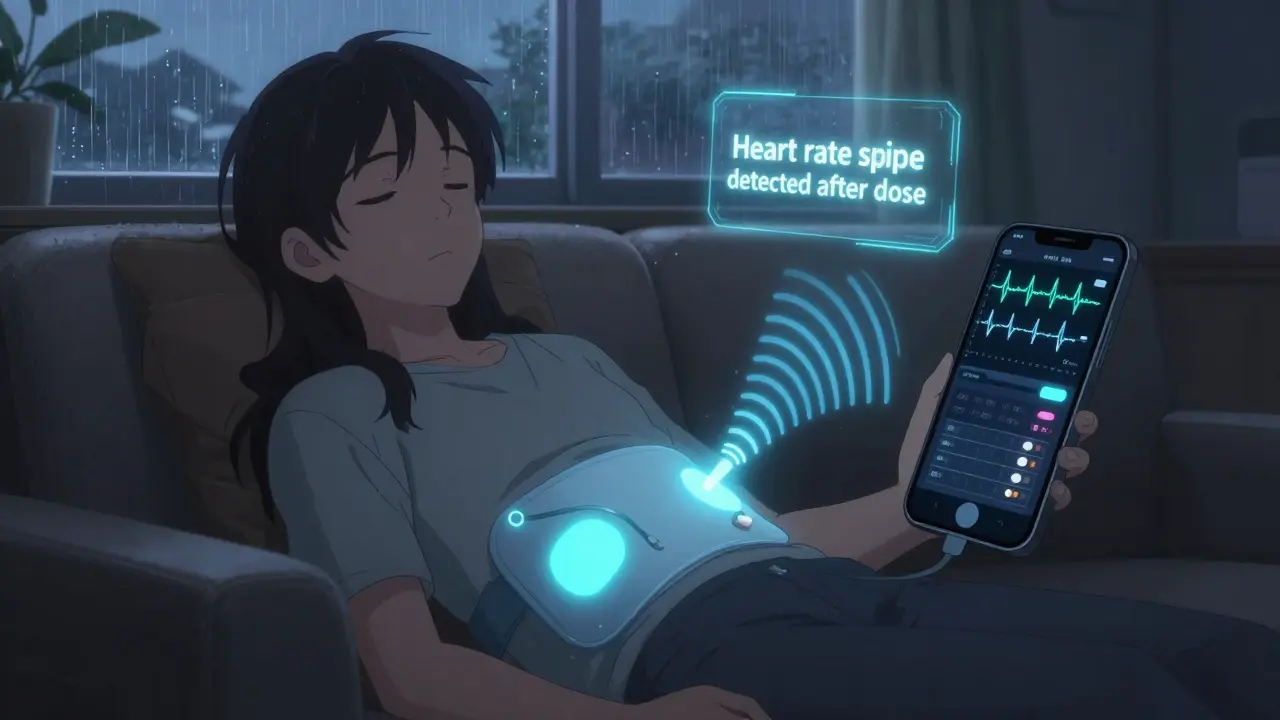
Who’s Using This Right Now?
Right now, digital pills are mostly used in two places: clinical trials and mental health care. About 78% of digital pill systems are used in research. Pharmaceutical companies use them to make sure patients in drug trials are actually taking the test medication. That’s critical - if people fake their adherence, the whole study is useless. In clinics, mental health is the biggest use case. The first FDA-approved digital pill, Abilify MyCite, contains aripiprazole for schizophrenia and bipolar disorder. Otsuka Pharmaceutical holds over half the market in this space. Why? Because non-adherence here is deadly. Studies show patients on digital pills for psychosis are 40% less likely to be readmitted to the hospital. Other areas are growing fast: HIV treatment, where missing doses breeds drug resistance; heart failure, where pills prevent fluid buildup; and diabetes, where timing matters as much as dosage. The market is expected to grow from $628 million in 2022 to over $2.4 billion by 2029.The Real Problems: Privacy, Cost, and Comfort
This isn’t a perfect solution. Many patients feel uneasy about being watched. In a survey of 412 users, 73% worried about privacy. One Reddit user said, “It felt like my psychiatrist was watching me swallow pills.” That’s not paranoia - it’s a real emotional burden. People fear their data could be used against them: by insurers, employers, or even family members. Then there’s the patch. Some users get skin irritation. In one trial, 22% quit because the adhesive burned or itched. Elderly patients struggled with the app. Nearly 40% needed help just connecting the patch to their phone. And cost? The pill itself adds $50-$100 per month to the bill. Most insurance won’t cover it yet. Medicare and private insurers are still figuring out how to pay for this. Right now, only 12% of uses are direct-to-consumer. The rest are locked inside research or hospital systems.
What’s Next? Smarter, Smaller, and More Predictive
The next generation of digital pills won’t just track ingestion - they’ll predict problems before they happen. By 2026, 60% of systems are expected to include side effect detection as standard. That means if your pill triggers a drop in oxygen levels or an abnormal heart rhythm, the system will alert your doctor before you even feel sick. Sensors are getting smaller. New designs are embedding sensors directly into the pill’s coating, eliminating the need for a separate patch. Some prototypes are even using wireless power from outside the body, so there’s no battery to die after 72 hours. And AI is getting smarter. Algorithms are learning what “normal” looks like for each person. If you usually take your pill at 8 a.m. and walk 8,000 steps afterward, but one day you skip it and stay in bed - the system doesn’t just say “missed dose.” It says, “This pattern matches your previous episode of depression. Would you like to talk to your provider?”Should You Use a Digital Pill?
If you’re managing a serious chronic condition - especially one where missing doses has real consequences - this technology could be life-saving. If your doctor recommends it, ask: How will this data be used? Who sees it? What happens if I miss a dose? But if you’re just taking a daily blood pressure pill and you’re generally good about it? The cost and hassle might not be worth it. This isn’t for everyone. It’s for people who need more than reminders. It’s for people who need proof - and protection. The goal isn’t to spy on patients. It’s to empower them. To turn medication from a chore into a partnership. To turn silence into insight. And maybe, just maybe, to save lives that slipped through the cracks of old-school healthcare.Are digital pills safe to swallow?
Yes. The sensors are made from biocompatible materials like silicon and copper-magnesium, which are non-toxic and pass through the digestive system naturally. They’re designed to break down harmlessly after use. No major safety issues have been reported in clinical trials involving thousands of patients.
Can digital pills replace regular medication?
No. Digital pills don’t deliver medicine - they just track whether you took it. The active drug is still the same pill you’ve always taken. The sensor is just a tiny tracker inside it. They’re a monitoring tool, not a treatment.
How long does the sensor last in the body?
The sensor activates only when it contacts stomach fluid and transmits data for a few minutes. After that, it becomes inactive. It passes through the digestive tract and is excreted naturally within 24 to 48 hours. It doesn’t stay in your body.
Is my data private?
Data is encrypted using AES or DES standards during transmission and stored on secure servers. HIPAA protects the data if it’s handled by a healthcare provider. However, privacy risks remain if data is shared with third parties like insurers or employers. Always ask who has access and how your data is used before signing up.
Can digital pills detect if I’m lying about taking my meds?
They can tell if the pill was ingested - not if you said you took it. If the sensor doesn’t activate, the system records a missed dose. But it can’t tell if you swallowed a placebo or faked the patch signal. It only confirms the pill reached your stomach. It’s not a lie detector - it’s a truth detector for physical ingestion.
Do I need a smartphone to use a digital pill?
Yes, currently. The wearable patch connects to a smartphone app via Bluetooth. The app sends data to the cloud and lets you and your provider view adherence reports. If you don’t have a smartphone or can’t use apps, you’ll need help from a caregiver or family member to manage the system.
Are digital pills covered by insurance?
Mostly not yet. Only a few Medicaid and private plans cover them, usually for specific conditions like schizophrenia or HIV. Medicare does not cover digital pills as of 2025. Coverage is expected to grow as clinical evidence shows cost savings from reduced hospitalizations, but reimbursement remains a major barrier.
Can I stop using the system if I change my mind?
Yes. You can stop wearing the patch at any time. The sensor in the pill is passive and doesn’t require activation. Once you stop using the system, your doctor will no longer receive data. There’s no permanent tracking or hidden monitoring. Your choice to discontinue is respected.
13 Responses
The sensor’s power source is a Mg-CuCl2 galvanic cell? That’s wild. Most people think it’s some fancy battery, but no-it’s literally stomach acid doing electrochemistry. The voltage output is barely enough to power a digital watch, yet it’s reliable enough for FDA approval. This isn’t AI magic, it’s solid-state bioelectrochemistry done right. The real breakthrough isn’t the sensor-it’s the regulatory pathway they carved out for ingestible electronics. Most medtech companies still can’t get past Phase 2 because of biocompatibility nightmares. Otsuka nailed it.
I’ve been on antipsychotics for 12 years. I’ve missed doses because I was too tired to get out of bed, because I forgot after a night out, because I was scared of the side effects. This tech doesn’t judge. It just records. And for the first time, my doctor didn’t say ‘Why aren’t you taking your meds?’-they said ‘You missed three doses last week. What’s going on?’ That changed everything. I started therapy. I got help. This isn’t surveillance. It’s compassion with data.
this is cool but what about people who dont have smartphones or data plans? its useless for them
I work in a clinic that uses Abilify MyCite. The biggest win isn’t adherence-it’s trust. Patients who used to hide their missed doses now say things like, ‘I skipped it because I was scared of the dizziness, but I didn’t know how to tell you.’ The system gives them a safe way to be honest. That’s more valuable than any stat. We’ve seen fewer ER visits, fewer crisis calls. It’s not perfect, but it’s humanizing care.
Let me get this straight-you’re okay with a chip in your poop that reports to Big Pharma and your insurance company? This isn’t healthcare, it’s behavioral control. They’ll start denying coverage if you ‘fail’ adherence. Next thing you know, your premiums go up because you slept in one morning and missed your pill. And don’t even get me started on the patch burning your skin. This is dystopian nonsense dressed up as innovation.
Been using one for HIV meds. Honestly? I didn’t think I’d stick with it. But the app started noticing when I’d skip doses after drinking, and it’d send a gentle nudge: ‘You usually take it after dinner. Want me to remind you?’ It didn’t shame me. It just… noticed. Now I take it every day. The patch? Yeah, it itches sometimes. But I’d rather itch than end up with drug-resistant HIV. This isn’t spy tech-it’s a lifeline. And yeah, I know the data’s encrypted. I’m not paranoid, I’m just cautious.
My mom has heart failure. She’s 78. She hates phones. We had to buy her a new iPhone just so she could use the patch. Her hands shake. She forgets how to unlock it. But she wears it anyway. Last month, the system flagged a spike in her heart rate after her diuretic. We called her cardiologist. Turned out it was a UTI-she didn’t even feel sick. They treated it early. She’s still alive because a tiny sensor in her stomach told a computer she was in trouble before she knew it herself.
Look, I get the fear. But if this tech saves even one person from a psychotic break or a heart attack, it’s worth the cost. You think it’s invasive? Try living with the guilt of knowing you missed your meds and your body paid the price. This isn’t about control-it’s about giving people back their dignity. You don’t have to use it. But don’t trash it because it makes you uncomfortable. Real people are using this to stay alive. That’s not a buzzword. That’s reality.
So you’re telling me the government and Big Pharma are putting tracking chips in our pills so they can monitor us? And you’re okay with that? What’s next? A sensor in your tooth that tells them when you’re stressed? They’re building a database of your every move. Your sleep. Your heart rate. Your pill habits. This isn’t medicine. It’s social credit. They’ll use this to deny you jobs, loans, insurance. You think your data is private? It’s not. It’s already being sold. Wake up.
People are making this way too complicated. You swallow a pill. It sends a signal. Big deal. You still have to take the actual drug. And if you’re too lazy to take your meds without a chip in your poop, maybe you shouldn’t be on them in the first place. This isn’t a solution-it’s a crutch for people who can’t manage basic responsibility. Also, $100 a month? For a sensor that does nothing but tell your doctor you’re lazy? No thanks. I’ll just take my pills like a grownup.
Indian healthcare system can't even deliver basic meds on time. You're talking about $100 digital pills? This is a luxury for rich Westerners. In rural India, people are still choosing between food and insulin. This tech is a distraction. Fix the supply chain first. Fix the doctor shortage. Fix the cost of generics. Then we can talk about sensors in poop. Until then, this is tech-washing for the privileged.
It’s funny how people call this surveillance when it’s literally the opposite. For years, we’ve been telling patients to ‘just take your pills.’ No support. No context. Just guilt. Now, instead of being yelled at, they’re asked, ‘What happened Friday?’ That’s not control-that’s care. I’ve seen patients cry because someone finally asked why they missed their dose instead of assuming they were just bad at following rules. This tech doesn’t spy. It listens.
Let’s be real-this is just another way for corporations to monetize compliance. The sensor costs pennies to make. The patch? A few dollars. But they charge $100/month because they know people with chronic illness will pay anything to avoid hospitalization. And now they’re training AI to predict your mental state based on your step count? That’s not medicine. That’s predictive profiling. And it’s only a matter of time before your insurance company uses this data to cancel your coverage. This isn’t innovation. It’s exploitation dressed in a lab coat.