

You wake up feeling like you’ve been hit by a truck. Your back aches, your joints are stiff, and your brain feels foggy. You blame the pain for keeping you awake all night. But what if the lack of sleep is actually making the pain worse? It’s not just a bad night; it’s a biological trap. Research shows that chronic pain and insomnia aren’t just neighbors-they’re co-conspirators. They feed each other in a loop that can make both conditions significantly harder to treat.
For years, doctors treated these as separate issues. You’d see a pain specialist for your knees and a sleep doctor for your insomnia, with little communication between them. That approach is outdated. A landmark study from the University of Washington showed that even short-term sleep loss drastically lowers pain tolerance. If you have chronic pain, you’re already fighting an uphill battle. Add poor sleep to the mix, and you’re essentially handing the pain more ammunition. Here’s how this cycle works, why it happens, and exactly what you can do to break it.
The Vicious Loop: Why Pain Keeps You Awake and Lack of Sleep Hurts More
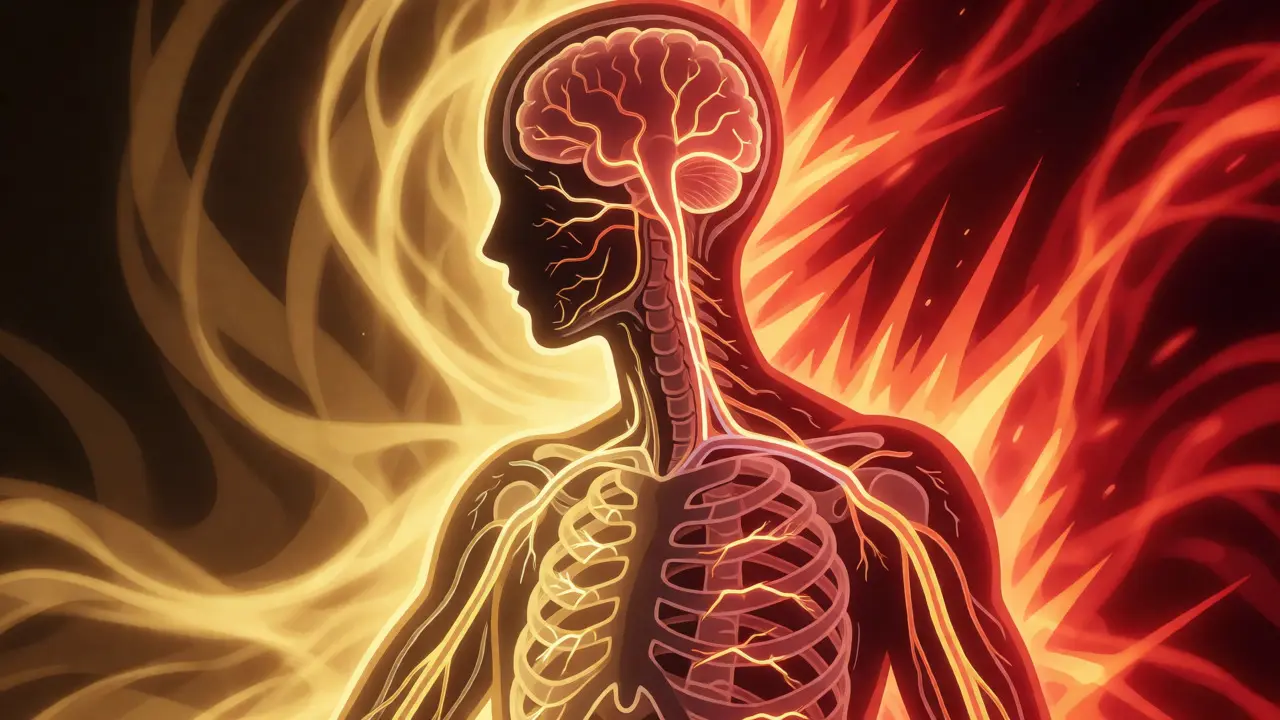
Think of your body’s pain control system like a thermostat in your house. When things are working right, the thermostat keeps the temperature stable. Sleep is one of the key regulators for that thermostat. When you don’t get enough rest, the thermostat breaks. It starts overreacting to small changes. In medical terms, this is called central sensitization. Your nervous system becomes hyper-alert, interpreting normal signals as painful ones.
A 2023 study published in Nature Communications by researchers at Harvard Medical School identified specific neural pathways that lock sleep deprivation and chronic pain together. They found that sleep loss dysregulates the brain’s internal pain control system. It’s not just that you’re tired and grumpy; your actual perception of pain changes. Studies show that sleep-deprived individuals experience a 10-20% drop in pain thresholds. This means a stimulus that wouldn’t hurt a well-rested person can cause significant pain when you’re exhausted.
The reverse is also true. Pain fragments your sleep. You might fall asleep fine, but you wake up every time you shift positions or feel a throb. These micro-awakenings prevent you from entering deep, restorative sleep stages. Without deep sleep, your body can’t repair tissues or clear out inflammatory chemicals. The result? You wake up with higher levels of inflammation, which causes more pain, which leads to worse sleep. It’s a self-perpetuating machine that runs on exhaustion.
The Biology Behind the Burnout
To fix the problem, you need to understand what’s happening under the hood. It’s not just "feeling bad." There are measurable chemical changes occurring in your brain and body when this cycle kicks in.
Your body has natural painkillers-endogenous opioids and dopamine systems-that help modulate pain signals. Sleep deficiency deactivates these systems. Research indicates that lack of sleep can reduce endogenous opioid activity by 30-40%. At the same time, it ramps up pro-inflammatory cytokines like IL-6 by 25-35%. Essentially, your body stops producing its own pain relief while simultaneously increasing the inflammation that causes pain.
| System | Effect of Sleep Loss | Impact on Pain |
|---|---|---|
| Endogenous Opioids | Activity drops by 30-40% | Reduced natural pain relief |
| Inflammatory Mediators | IL-6 increases by 25-35% | Increased tissue inflammation |
| Dopamine Signaling | Levels drop by 20-30% | Dysfunctional analgesia and mood |
| Kappa Opioid Receptors | Dysregulated activation | Heightened pain sensitivity |
Dr. Frank Porreca at the University of Arizona discovered that kappa opioid receptors play a critical role here. In preclinical models, targeting these receptors improved sleep quality by 40-60%. This suggests that treating the sleep issue isn't just about comfort-it's about correcting a neurological imbalance that directly fuels pain perception.
Why Treating Pain Alone Often Fails
If you’ve ever taken strong painkillers only to find they don’t work as well as they used to, your sleep might be the culprit. Clinical evidence shows that chronic pain patients with comorbid insomnia report 35-45% higher pain intensity than those who sleep well. They also suffer from 40% greater anxiety and depression, which further amplifies pain perception.
Consider the data from the American Academy of Sleep Medicine: 54% of chronic pain patients meet the criteria for insomnia disorder, compared to just 10-15% of the general population. Yet, many treatment plans ignore this statistic. A patient named Sarah M., dealing with fibromyalgia, noted in online forums that four nights of poor sleep could spike her pain from a manageable 4/10 to an unbearable 8/10. She reported it took two weeks to recover after her sleep finally improved. This isn't an anomaly; it's the standard pattern for many.
Ignoring sleep creates fragmented care. Trustpilot reviews for pain clinics highlight this gap. Patients who received integrated treatment-addressing both pain and sleep-reported satisfaction rates of 4.7/5. Those who only received pain management scored 3.2/5. The difference? Integrated care acknowledges that you cannot effectively manage pain if the brain’s processing center (the sleep-wake cycle) is malfunctioning.
The Gold Standard: Cognitive Behavioral Therapy for Insomnia (CBT-I)
So, how do you break the cycle? Sleeping pills often fail long-term. They can cause next-day grogginess, which worsens pain perception, and they don’t address the root behavioral causes. The most effective intervention, backed by extensive research, is Cognitive Behavioral Therapy for Insomnia (CBT-I).
CBT-I is not talk therapy in the traditional sense. It’s a structured program that retrains your brain and body to associate bed with sleep, rather than pain and frustration. Studies show CBT-I reduces insomnia symptoms in 65-75% of cases and decreases pain intensity by 30-40% after 8-10 sessions. It works by fixing sleep efficiency-the ratio of time spent asleep to time spent in bed.
Here is what a typical CBT-I protocol involves:
- Sleep Restriction: Limiting time in bed to match actual sleep time, building sleep pressure.
- Stimulus Control: Using the bed only for sleep and sex, removing distractions like phones or TV.
- Cognitive Restructuring: Challenging anxious thoughts about pain and sleeplessness.
- Relaxation Techniques: Progressive muscle relaxation or guided imagery to lower physiological arousal.
For those who can’t access a therapist, digital platforms like Sleepio offer similar benefits, though completion rates are lower. However, the core principles remain the same: consistency and reconditioning. Dr. Nicole K.Y. Tang at King’s College London emphasizes that patients often prioritize sleep improvement over pain reduction because better sleep gives them a sense of control. And control is powerful when you’re dealing with chronic illness.

Practical Steps to Break the Cycle Tonight
You don’t need a prescription to start disrupting this loop. Small, consistent changes can yield significant results. Start by tracking your patterns. Use a simple diary for 14 days. Note down when you go to bed, when you wake up, how many times you wake during the night, and your pain level upon waking. This data helps identify triggers.
Once you have your baseline, implement these rules:
- Keep a Consistent Wake Time: Regardless of how poorly you slept, get up at the same time every day. This anchors your circadian rhythm.
- Optimize Your Environment: Keep the bedroom cool (around 65°F/18°C), dark, and quiet. For pain sufferers, support matters. Use pillows to align your spine or relieve pressure points. If arthritis affects your hands, keep splints nearby.
- Limit Naps: If you must nap, keep it under 20 minutes and before 3 PM. Long naps steal sleep pressure from the night.
- Manage Pre-Sleep Pain: Take pain medication 30-60 minutes before bed so peak efficacy coincides with sleep onset. Apply heat or ice to sore areas right before getting into bed.
- Get Out of Bed if Awake: If you haven’t fallen asleep in 20 minutes, get up. Go to another room and do something boring until you’re sleepy. Staying in bed while in pain reinforces the association between bed and suffering.
Avoid alcohol as a sleep aid. While it may help you fall asleep, it fragments sleep architecture and reduces REM sleep, leading to poorer recovery and increased pain sensitivity the next day. Similarly, be cautious with over-the-counter antihistamines; they can cause dry mouth and next-day drowsiness, which interferes with daytime pain management activities.
When to Seek Professional Help
Self-help strategies are great, but chronic pain and insomnia often require professional coordination. If your Insomnia Severity Index (ISI) score is above 15, you likely need targeted intervention. Look for providers who specialize in interdisciplinary pain management. Ideally, you want a team that includes a pain specialist, a sleep medicine physician, and a behavioral health provider.
New pharmacological approaches are emerging. Researchers are testing drugs that target kappa opioid receptors, showing promise in improving both sleep and pain scores in clinical trials. However, medication should complement, not replace, behavioral changes. The goal is to reset your biology so that your body can handle pain signals more effectively.
Remember, breaking the cycle takes time. It’s not a switch you flip overnight. But by prioritizing sleep hygiene and seeking integrated care, you can stop feeding the monster. Better sleep doesn’t just mean less fatigue; it means less pain. It’s the most potent, side-effect-free painkiller available-if you know how to use it.
Does lack of sleep really make pain worse?
Yes. Research consistently shows that sleep deprivation lowers pain thresholds by 10-20%. It disrupts the brain's ability to process pain signals correctly, causing normal sensations to feel painful and existing pain to feel more intense. This is due to increased inflammation and reduced activity in the body's natural pain-relief systems.
Can I take sleeping pills to break the pain-sleep cycle?
Sleeping pills can provide short-term relief but are rarely a long-term solution. They often cause next-day grogginess, which can worsen pain perception and limit physical activity. Furthermore, they do not address the underlying behaviors driving insomnia. Cognitive Behavioral Therapy for Insomnia (CBT-I) is generally more effective for chronic conditions.
What is CBT-I and how does it help with pain?
CBT-I (Cognitive Behavioral Therapy for Insomnia) is a structured program that helps identify and replace thoughts and behaviors that cause or worsen sleep problems. By improving sleep efficiency and reducing anxiety around sleep, CBT-I can decrease pain intensity by 30-40% in chronic pain patients, according to clinical studies.
How long does it take to break the insomnia-pain cycle?
Improvements can begin within 2-4 weeks of consistent sleep hygiene practices or starting CBT-I. However, fully reversing the neurobiological changes associated with chronic pain and insomnia may take several months. Patience and consistency are key, as setbacks are common initially.
Should I tell my pain doctor about my sleep issues?
Absolutely. Up to 54% of chronic pain patients have clinically significant insomnia. Many pain treatments are less effective if sleep is poor. Informing your doctor allows for integrated care, where they might adjust medications to avoid sleep-disrupting side effects or refer you to a sleep specialist.
15 Responses
Finally someone says it! In India we have known this for generations, you sleep wrong you hurt more. Doctors here just give pills and ignore the root cause. This is why our healthcare system is a mess compared to what they do in top tier countries. We need to stop accepting mediocrity.
The United States medical establishment has been ignoring this connection for decades while other nations advanced integrated care models. It is infuriating that American patients are subjected to fragmented treatment plans that fail to address the holistic nature of chronic conditions. This article validates what many of us have suspected: the system is broken by design, not accident.
OMG this is literally my life 😭💤 The cycle is so real and exhausting. I tried CBT-I last year and honestly it was the only thing that helped my fibro flare-ups. Sleeping pills made me feel like a zombie 🧟♀️ which made the pain worse lol. If you haven't tried retraining your brain for sleep, please do it before buying another bottle of melatonin. You got this bestie ✨
whatever. just another health fad. i tried sleeping better for a week and my back still hurts. probably just placebo effect anyway.
I appreciate the depth of this analysis. It is truly profound how interconnected our physiological systems are. When one pillar crumbles, the entire structure suffers. We must approach our health with compassion and patience, recognizing that healing is a journey rather than a destination. Your words offer a beacon of hope for those suffering in silence.
this makes sense. i used to think my pain was just bad luck but now i see the pattern. less pressure on myself to fix it all at once helps too
Wait, hold up. Is there actual data on specific pillow types affecting deep sleep stages? Like, does memory foam vs latex actually change the inflammatory markers mentioned? I'm trying to optimize my setup without spending a fortune, and the science feels a bit vague on the hardware side. Would love some concrete specs if anyone knows!
The reliance on anecdotal evidence and digital platforms like Sleepio suggests a lack of rigorous clinical oversight in current mainstream recommendations. While CBT-I has merit, the generalization of its efficacy across diverse pain etiologies is scientifically lazy. One must distinguish between nociceptive pain and neuropathic conditions when applying these protocols.
the central sensitization part is key. once the nervous system gets stuck in overdrive regular hygiene tips might not be enough. interdisciplinary approach is the way forward imo
Great info bro!! I started doing the consistent wake time rule 2 weeks ago and feeling much better already. Don't give up guys, small changes add up big time. Keep pushing 💪🏼
This analysis is superficially comforting but fails to address the socioeconomic disparities inherent in accessing CBT-I. Most individuals cannot afford eight to ten sessions of specialized therapy. To suggest that behavioral modification alone resolves neurobiological dysregulation ignores the systemic barriers faced by lower-income populations. The author's tone is dismissive of structural inequality.
Actually...; the study cited from Harvard is often misinterpreted.; People confuse correlation with causation.; Just because you sleep poorly and hurt more doesn't mean one causes the other directly.; Maybe both are symptoms of an underlying issue like depression.; Everyone is so quick to jump on the bandwagon.; Wake up sheeple.;;;
Love this post! Sharing with my sister who deals with migraines. Hope she finds some relief soon. Stay strong everyone!
It is highly suspicious that pharmaceutical companies fund studies linking sleep to pain. They want you dependent on their new 'sleep-pain' drugs targeting kappa receptors. The government hides the fact that simple fasting and cold exposure reset the system naturally. Do not let them manipulate your biology for profit. Read between the lines.
@Adam Viruet you are clearly ignorant of basic physiology. The causal link is established in animal models where sleep deprivation induces hyperalgesia directly. Your skepticism is misplaced and stems from a lack of education. In developed nations we accept scientific consensus, unlike some who cling to conspiracy theories. Go read a textbook.