
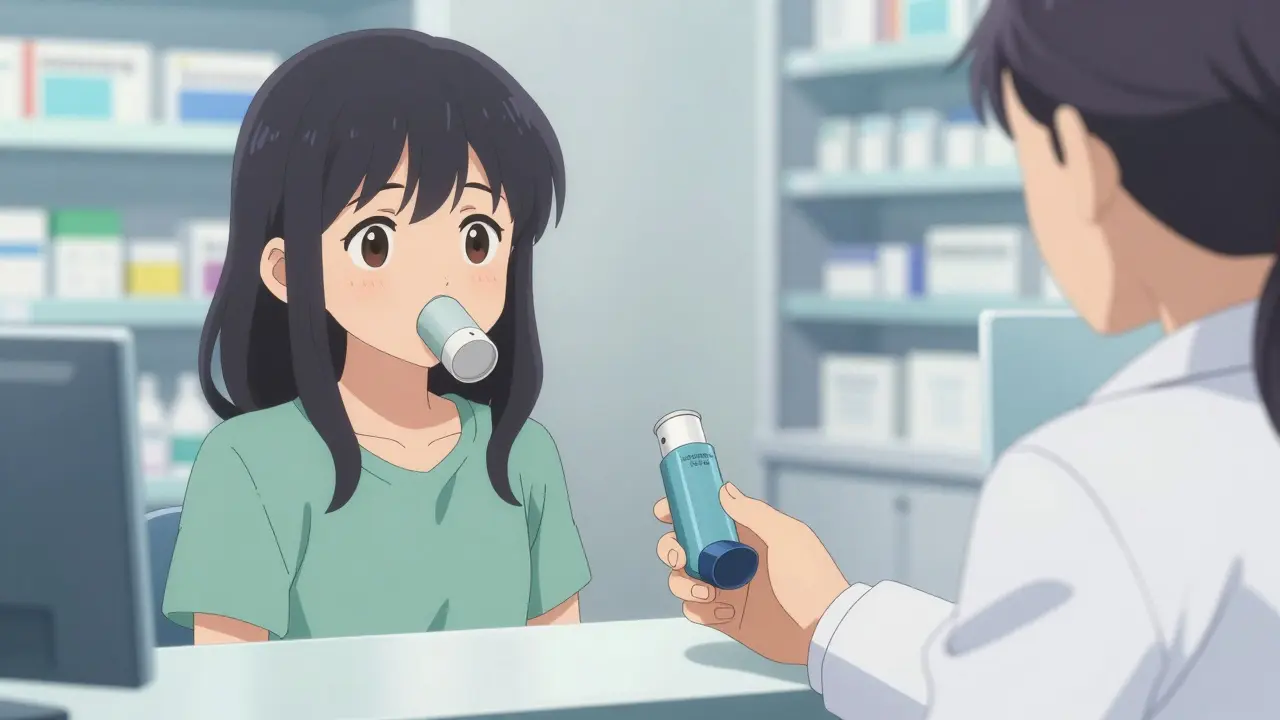
Imagine you’ve been using a specific asthma inhaler for years. It works. You trust it. Then your pharmacy hands you a generic version because the brand name is too expensive. The box looks different. The click sounds slightly louder. Does it still work the same way in your lungs? This question sits at the heart of bioequivalence, a critical concept in pharmaceutical science that ensures generic drugs perform just like their brand-name counterparts. For simple pills, this process is straightforward. But for special delivery systems like inhalers, transdermal patches, and specialized injections, proving equivalence is far more complex.
Traditional bioequivalence relies on measuring how much drug enters the bloodstream over time. However, when a drug acts locally-like steroids in an inhaler-or bypasses the digestive system entirely, blood tests alone don’t tell the whole story. Regulatory agencies like the FDA and EMA have had to adapt their rules to handle these "complex generics." Understanding these adaptations helps manufacturers navigate approval hurdles and gives healthcare providers confidence in prescribing alternatives.
Why Special Delivery Systems Break the Rules
The standard rule for most oral generics is the 80-125% criterion. If a generic drug delivers between 80% and 125% of the active ingredient compared to the reference product, it’s considered bioequivalent. This works well for tablets that dissolve in the stomach and absorb into the gut. But special delivery systems operate differently.
For locally acting products, such as inhaled corticosteroids, the goal isn’t systemic absorption-it’s deposition in the airways. Measuring plasma concentrations might show low levels of the drug in the blood, which could be misinterpreted as poor performance if you’re only looking at traditional metrics. Instead, regulators require evidence that the drug reaches the target tissue effectively. Similarly, transdermal patches release medication slowly through the skin, creating a sustained profile that doesn’t fit neatly into peak concentration models.
This complexity stems from the definition of bioequivalence itself. According to 21 CFR 320.1, bioequivalence is the absence of significant difference in the rate and extent to which the active ingredient becomes available at the site of action. When the "site of action" is the lung epithelium or the dermis rather than the general circulation, proving this requires a totality-of-evidence approach. This includes physicochemical properties, in vitro testing, and sometimes clinical endpoints.
Inhalers: Particle Size and Plume Geometry
What makes inhaler bioequivalence so difficult?
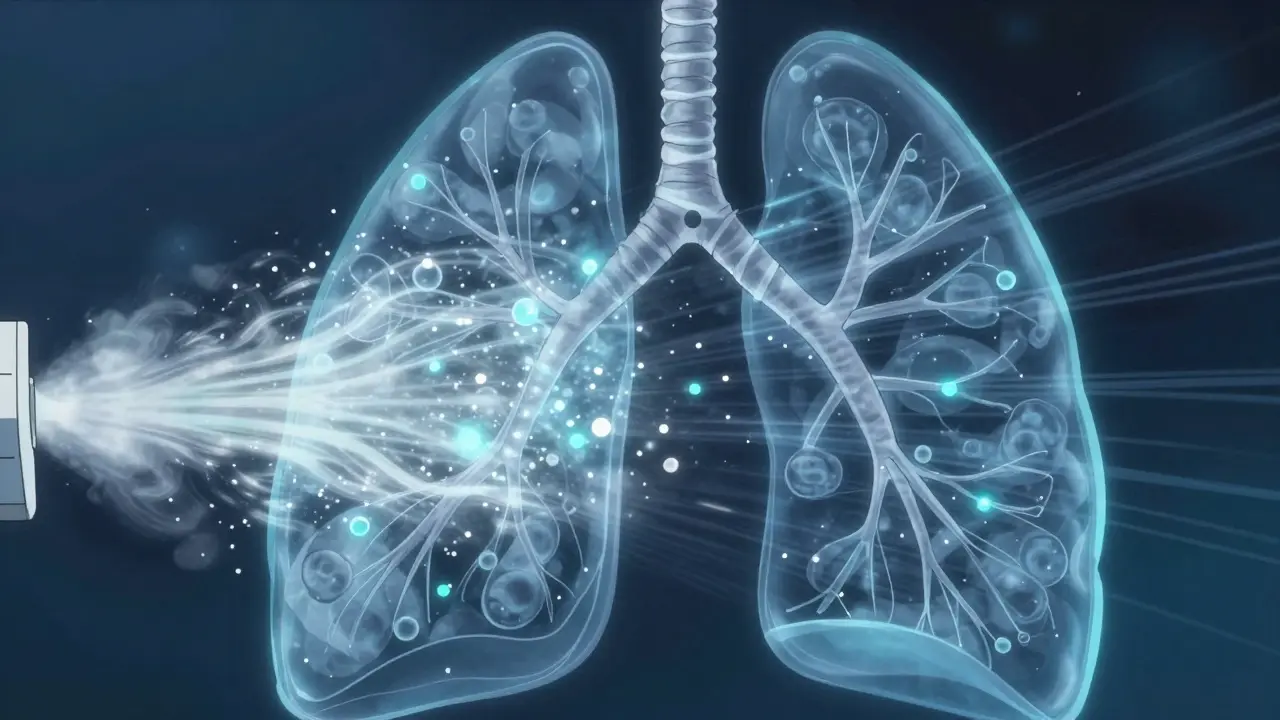
Inhalers depend on precise engineering. The drug must be delivered as particles small enough to reach deep into the lungs (typically 1-5 micrometers). If the particles are too large, they get stuck in the throat; too small, and they are exhaled. Generic manufacturers must match not just the drug content but the device mechanics.
Inhalers present one of the toughest challenges in generic development. The FDA’s 2022 guidance for Metered Dose Inhalers (MDIs) and Dry Powder Inhalers (DPIs) mandates rigorous in vitro testing before any human trials begin. Key parameters include particle size distribution, where 90% of particles must fall within the respirable range. Delivered dose uniformity must stay within 75-125% of the labeled claim. Even plume geometry-the shape and temperature of the spray-matters.
Consider a real-world failure case. A generic albuterol MDI was rejected by the FDA because its plume temperature was 2°C higher than the reference product. While the drug amount was identical, the warmer plume altered patient perception and potentially deposition patterns. For locally acting inhalers, pharmacodynamic endpoints like FEV1 (forced expiratory volume) may replace standard pharmacokinetic studies. The EMA requires identical dose delivery within a 10% difference and similar fine particle fractions.
Developing an equivalent inhaler often takes 36-48 months and costs $25-40 million. This is significantly higher than the $5-10 million for standard oral generics. Companies like Teva have succeeded by using advanced imaging techniques like scintigraphy to visualize lung deposition directly, proving equivalence beyond just chemical analysis.
Transdermal Patches: Adhesion and Release Rates
Transdermal patches deliver drugs continuously through the skin, avoiding first-pass metabolism. Examples include nicotine patches for smoking cessation or fentanyl patches for pain management. Because the release is sustained, the sharp peak seen with oral doses is absent. This changes how bioequivalence is assessed.
The FDA’s 2011 guidance for transdermal systems focuses heavily on in vitro release rates. The generic patch must release the drug at a rate within 10% of the reference product at all time points. Skin adhesion is equally critical. If a patch falls off prematurely, therapeutic levels drop dangerously. Residual drug content after removal must also be comparable to ensure consistent dosing.
Interestingly, the standard 80-125% bioequivalence limit applies to the Area Under the Curve (AUC), which measures total exposure, but not necessarily to Cmax (peak concentration). Since patches aim for steady-state delivery, Cmax variability is less clinically relevant. For highly variable drugs, regulators may accept reference-scaled average bioequivalence approaches. However, establishing a valid in vitro-in vivo correlation (IVIVC) remains a hurdle. Only 35% of companies report success in developing validated IVIVCs for these systems, according to a 2023 survey.
Market data shows that generic transdermal patches achieve 65% market penetration within three years of patent expiration. This high adoption rate suggests that once equivalence is proven, patients and providers readily switch, provided the adhesion and comfort match the original.
Injections: Complex Formulations and Nanoparticles
Injectables are often assumed to be 100% bioavailable since they enter the body directly. However, complex injectables like liposomal formulations, nanoparticles, or monoclonal antibodies behave differently. The drug isn’t just dissolved; it’s encapsulated or bound to carriers that control release.
The FDA’s 2018 guidance on complex products requires demonstration of identical physicochemical properties. For nanoparticle-based drugs, this means matching size distribution within 10%, maintaining a polydispersity index below 0.2, and ensuring zeta potential stays within 5mV. These tiny differences can drastically change how the immune system reacts or how quickly the drug releases.
Narrow therapeutic index drugs, such as enoxaparin (Lovenox), face even stricter limits. The FDA requires bioequivalence limits of 90-111% for both AUC and Cmax, compared to the standard 80-125%. This tighter window reflects the risk of toxicity if the dose varies slightly. Recent developments include draft guidance for monoclonal antibodies, introducing novel approaches for biosimilars delivered via injection. Physiologically-based pharmacokinetic (PBPK) modeling is increasingly used here, with 65% of complex generic submissions in 2022 including PBPK analyses.
A notable failure occurred in 2021 when the FDA rejected a generic Bydureon BCise. The issue wasn’t the drug itself but the auto-injector mechanism. Differences in the device affected the drug delivery profile, leading to inconsistent absorption. This cost the sponsor approximately $45 million. It highlights that for complex injectables, the device is part of the drug product.
Comparison of Bioequivalence Requirements
| Delivery System | Primary In Vitro Tests | Clinical Endpoint Focus | Typical Cost Range | Approval Rate |
|---|---|---|---|---|
| Oral Tablets | Dissolution testing | Plasma PK (Cmax, AUC) | $5-10 Million | 78% |
| Inhalers (MDI/DPI) | Particle size, Plume geometry | Lung deposition, FEV1 | $25-40 Million | 38% |
| Transdermal Patches | Release rate, Adhesion | Steady-state PK | $15-25 Million | 52% |
| Complex Injectables | Size distribution, Zeta potential | Immunogenicity, PK/PD | $30-50 Million | 58% |
As the table illustrates, the barrier to entry for complex generics is significantly higher. Inhalers have the lowest approval rate at 38%, reflecting the stringent requirements for particle engineering. Transdermal patches fare better at 52%, while complex injectables sit at 58%. Standard oral generics enjoy a 78% approval rate, underscoring why many developers stick to simpler dosage forms despite lower margins.

Practical Challenges for Developers
Getting started with complex generic development requires specialized infrastructure. Cascade impactors for inhaler testing cost between $150,000 and $300,000. Franz diffusion cells for transdermal studies run $50,000 to $100,000. Particle characterization systems for injectables can exceed $200,000. Beyond equipment, teams need 18-24 months of specialized training to conduct appropriate studies.
Establishing in vitro-in vivo correlations (IVIVC) is a major bottleneck. Without a validated IVIVC, every minor formulation change requires new clinical trials, skyrocketing costs. Many companies partner with specialized Contract Research Organizations (CROs) like Alimentiv or PRA Health Sciences to bridge this gap. Alimentiv conducted 47 inhaler bioequivalence studies in 2022 alone, highlighting the niche expertise required.
Regulatory uncertainty adds another layer of difficulty. While the FDA and EMA provide guidance, they often emphasize a case-by-case review. The Global Bioequivalence Harmonization Initiative (GBHI) has worked since 2017 to standardize approaches, but full alignment remains elusive. Developers must stay updated with quarterly updates from the FDA’s Complex Generic Drug Products portal and monthly Q&A documents from the EMA.
Future Trends and Market Outlook
The global market for complex generics was valued at $78.3 billion in 2022 and is projected to reach $112.6 billion by 2027. This growth is driven by patent expirations of high-value specialty drugs like Humira and Stelara. However, regulatory hurdles will likely keep competition limited. Most complex generics will see only 2-3 competitors, compared to 8-10 for standard generics.
One emerging risk is "biocreep," a phenomenon where multiple generations of generics accumulate small differences that collectively impact clinical performance. Each generic matches its immediate predecessor, but over several switches, the final product may drift from the original reference. Regulators are increasingly aware of this, pushing for tighter controls and better lifecycle management.
Technological advancements offer solutions. PBPK modeling allows developers to simulate drug behavior without extensive human trials. Advanced imaging techniques provide direct visualization of drug deposition. As these tools mature, the cost and time for developing complex generics should decrease, making them more accessible to smaller players.
Can I switch between brand and generic inhalers safely?
Generally, yes, if the generic has passed FDA bioequivalence standards. However, because inhalers rely on device mechanics, some patients may notice differences in feel or taste. Always consult your doctor before switching, especially if you have severe asthma or COPD. They may monitor your lung function closely during the transition.
Why do generic patches sometimes fail to stick?
Adhesion is a critical quality attribute tested during bioequivalence studies. If a generic patch fails to stick, it likely didn’t meet the FDA’s adhesion property requirements. Poor adhesion leads to inconsistent drug delivery. If you experience issues, report them to the manufacturer and your pharmacist, as batch variations can occur.
Are complex generics cheaper than brand names?
Yes, but usually less so than oral generics. Due to higher development costs ($25-40 million vs $5-10 million), complex generics often retain a premium price. However, they are still typically 20-50% cheaper than the brand-name equivalent, offering significant savings for insurers and patients.
What is the role of PBPK modeling in bioequivalence?
Physiologically-Based Pharmacokinetic (PBPK) modeling uses computer simulations to predict how a drug behaves in the body. It’s increasingly used for complex generics to reduce the need for large clinical trials. By 2022, 65% of complex generic submissions included PBPK analyses, up from 22% in 2018.
How does the EMA differ from the FDA in assessing inhalers?
Both agencies require rigorous testing, but the EMA places strong emphasis on therapeutic equivalence in clinical outcomes like asthma control. The FDA focuses heavily on physicochemical properties and in vitro performance. The EMA’s 2019 guideline mandates identical dose delivery within 10%, while the FDA allows slightly wider ranges for certain parameters depending on the specific product type.