

Your skin is supposed to be a fortress. It keeps water in and irritants out. But if you have Atopic Dermatitis, commonly known as eczema, that fortress has cracks. The problem isn't just dryness; it's a structural failure of your skin's outer layer. To fix it, you can't just slap on any moisturizer. You need to understand the biology of the stratum corneum-the top layer of your epidermis-and use specific ingredients to rebuild it from the ground up.
The good news? Science has pinpointed exactly what’s missing. It’s not just "moisture." It’s lipids. Specifically, Ceramides. These are waxy lipids that make up about 50% of the mortar holding your skin cells together. When you restore these with the right bathing habits, you don’t just soothe symptoms-you repair the barrier itself. Here is how to do it effectively, based on current dermatological research.
The Brick-and-Mortar Reality of Your Skin
To understand why your skin feels tight and itchy, imagine a brick wall. The bricks are your dead skin cells (corneocytes). The mortar is a mixture of lipids. In healthy skin, this mortar is a precise blend of three ingredients:
- Ceramides: 50% of the mix.
- Cholesterol: 25% of the mix.
- Free Fatty Acids: 10-15% of the mix.
This creates a 3:1:1 molar ratio that forms a waterproof seal. If you have eczema, studies show your body produces significantly less of these lipids-sometimes up to 50% less than normal. Worse, the composition is wrong. You might have too many short-chain ceramides that don't hold water well. This leads to Transepidermal Water Loss (TEWL), where water evaporates from your skin rapidly, causing dehydration and letting allergens sneak in.
Simply adding water or oil isn't enough. If you apply a product with only ceramides, or only cholesterol, your skin can't rebuild the structure. Research by Bouwstra et al. (2003) found that incomplete mixtures actually result in suboptimal barrier recovery. You need all three components in the correct physiological ratio to trigger true repair.
Why Generic Moisturizers Often Fail
Most drugstore lotions rely on petrolatum (petroleum jelly) or mineral oil. These are occlusives. They sit on top of your skin like plastic wrap, trapping whatever moisture is already there. They reduce TEWL temporarily by 20-30%, but they don't fix the underlying structural deficit.
In contrast, ceramide-dominant emollients act as building blocks. Products like EpiCeram or TriCeram are formulated to mimic that natural 3:1:1 ratio. Clinical trials published in the Journal of Dermatological Science (2018) showed that these formulations reduced TEWL by 35-50% and maintained barrier integrity for over 72 hours after application. That’s a significant difference from the few hours you get from standard creams.
| Feature | Traditional Occlusive (e.g., Petrolatum) | Physiological Lipid Emulsion (e.g., EpiCeram/TriCeram) |
|---|---|---|
| Mechanism | Sits on surface (occlusive) | Integrates into skin structure (restorative) |
| TEWL Reduction | 20-30% | 35-50% |
| Durability | Short-term (hours) | Long-term (72+ hours) |
| Key Ingredients | Petrolatum, Mineral Oil | Ceramides, Cholesterol, Free Fatty Acids (3:1:1) |
| Best For | Locking in hydration | Repairing damaged barrier |
Don’t be fooled by marketing terms like "pseudo-ceramides." Some cheaper products use synthetic versions that don’t bond correctly with your skin proteins. Look for products that specify "physiological" or "natural" ceramides, ideally derived from plant sources like rice bran or wheat germ, which closely mimic human skin lipids.

The "Soak and Seal" Method: A Step-by-Step Guide
Even the best cream won’t work if you wash it away or apply it incorrectly. The gold standard for applying barrier repair creams is the "soak and seal" method. This technique leverages physics: damp skin absorbs lipids much more efficiently than dry skin.
- Soak: Take a lukewarm bath or shower for 10-15 minutes. The water temperature should be no hotter than 32°C (90°F). Hot water strips natural oils and increases inflammation. Use a gentle, fragrance-free cleanser with a pH around 5.5. Avoid harsh sulfates like sodium lauryl sulfate (SLS), which can increase water loss by up to 40% within an hour.
- Pat Dry: Gently pat your skin with a soft towel. Do not rub. Leave your skin slightly damp-not dripping wet, but visibly moist.
- Seal: Within three minutes of getting out of the water, apply your ceramide-rich emulsion. This window is critical. As your skin dries naturally, it loses heat and hydration quickly. Applying the cream while damp locks in that water and allows the lipids to penetrate deeper into the stratum corneum.
Research by Choi et al. (2016) indicates that applying emollients to damp skin can increase absorption by 50-70%. If you wait until your skin is bone dry, the product sits on top and does less work.
Bathing Habits That Sabotage Your Barrier
Your daily routine might be undoing your hard work. Here are common mistakes that damage the skin barrier:
- Over-bathing: While cleanliness is important, excessive bathing removes natural lipids. Limit baths to once daily. If you sweat heavily, rinse quickly with cool water and reapply your barrier cream immediately.
- Using Hot Water: Heat dilates blood vessels, triggering histamine release and itching. It also dissolves the lipid matrix faster. Stick to lukewarm temperatures.
- Scrubbing: Physical exfoliation is brutal for eczema-prone skin. It physically tears off the fragile corneocytes. Let the chemical action of gentle cleansers do the work.
- Fragranced Products: Fragrance is one of the most common contact allergens. Even "natural" essential oils can irritate compromised barriers. Stick to unscented, hypoallergenic formulas.
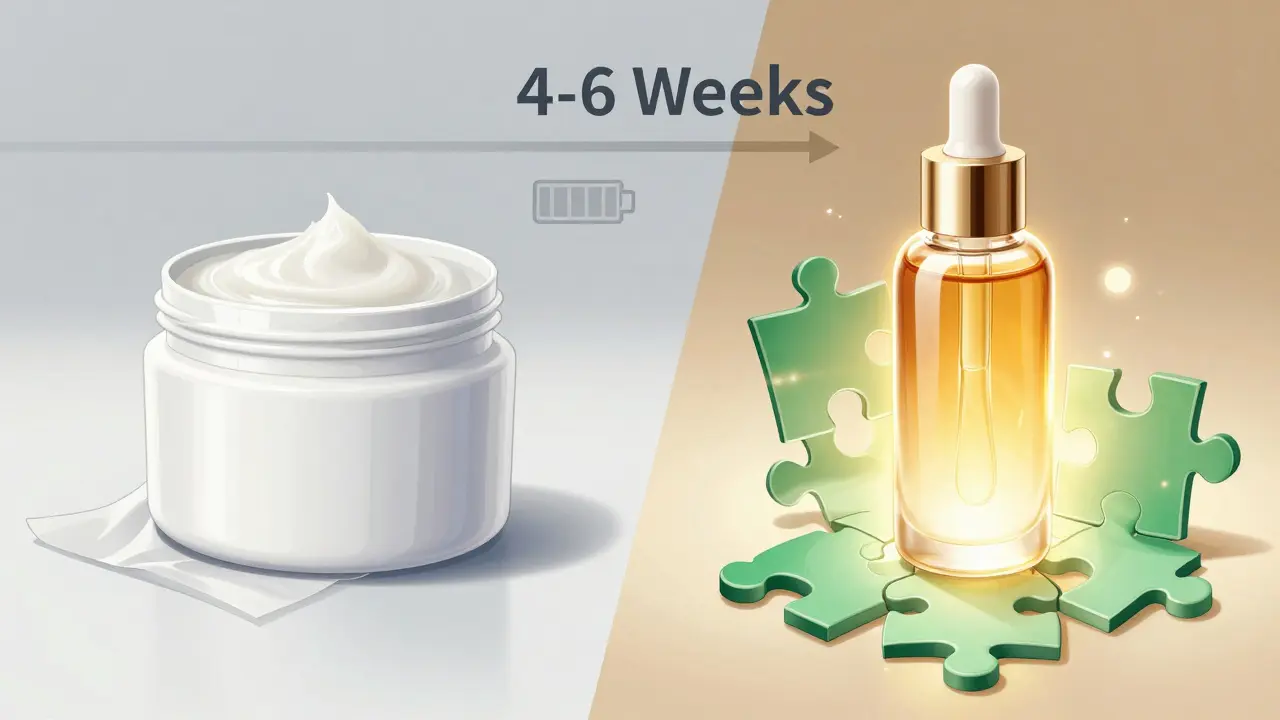
Managing Expectations: Time and Consistency
If you’re used to topical steroids, you’ll notice a difference in days. Steroids suppress inflammation quickly. Ceramide repair is different. It’s construction work, not fire-fighting. You won’t see dramatic changes overnight.
Clinical data suggests it takes 4-6 weeks of consistent, twice-daily application to see significant improvement in barrier function. During acute flares, you may still need steroids to calm the itch and redness. However, using ceramide emollients alongside steroids can reduce the amount of steroid needed over time. A case study in the Dermatology Online Journal (2021) documented a patient who reduced her steroid use from daily to once weekly after eight weeks of consistent barrier repair therapy.
Be prepared for some initial sensations. About 25% of users report a slight "tightness" during the first week as the skin adjusts to the new lipid balance. This usually resolves as the barrier strengthens. If you experience persistent burning or rash, stop use and consult a dermatologist, as you may be sensitive to another ingredient in the formulation.
Choosing the Right Product
Not all ceramide products are created equal. Prescription options like EpiCeram and TriCeram are FDA-approved medical devices (Class II) because they meet strict efficacy standards. Over-the-counter (OTC) brands like CeraVe contain ceramides but often in lower concentrations or without the exact 3:1:1 ratio required for clinical-grade repair.
For mild eczema, a high-quality OTC product with multiple ceramide types (NP, AP, AS) might suffice. For moderate-to-severe atopic dermatitis, prescription-strength emulsions offer superior results. Check the ingredient list: Ceramides should be listed near the top, followed by Cholesterol and Fatty Acids. If you see "Pseudo-Ceramide," know that it’s a synthetic alternative that may not integrate as effectively.
Cost is a factor. Prescription barrier creams cost significantly more than generic moisturizers-often $25-$35 per tube versus $5-$15. However, consider the long-term value. By reducing flare-ups and steroid dependence, you may save money on other treatments and avoid the cycle of chronic inflammation.
How long does it take for ceramides to repair the skin barrier?
Significant barrier repair typically takes 4 to 6 weeks of consistent, twice-daily application. While you may feel immediate relief from dryness, the structural rebuilding of the stratum corneum is a gradual process. Clinical improvements in transepidermal water loss (TEWL) and hydration levels are usually measurable after 21-28 days.
Can I use ceramide creams with topical steroids?
Yes, and it is often recommended. Apply the steroid first to treat active inflammation, wait 15-20 minutes for it to absorb, then apply the ceramide emulsion as a maintenance layer. This combination approach can help reduce the frequency and potency of steroids needed over time.
What is the "3:1:1 ratio" in skincare?
The 3:1:1 ratio refers to the molar proportion of lipids in healthy human skin: 3 parts Ceramides, 1 part Cholesterol, and 1 part Free Fatty Acids. This specific balance is crucial for forming the lamellar bilayers that create a waterproof barrier. Products lacking this ratio may not provide effective barrier repair.
Is it better to bathe in the morning or evening for eczema?
Evening baths are generally preferred because they allow you to "seal" your skin before bed, protecting it from friction against bedding and minimizing nighttime itching. The key is consistency: bathe once daily and always follow with the "soak and seal" method within three minutes of drying off.
Do over-the-counter ceramide products work as well as prescription ones?
For mild dryness, OTC products can be effective. However, for diagnosed atopic dermatitis, prescription emulsions like EpiCeram or TriCeram have undergone rigorous clinical trials proving their ability to reduce TEWL by up to 50%. OTC products vary widely in concentration and ratio accuracy, so check labels carefully for the full physiological lipid mix.