
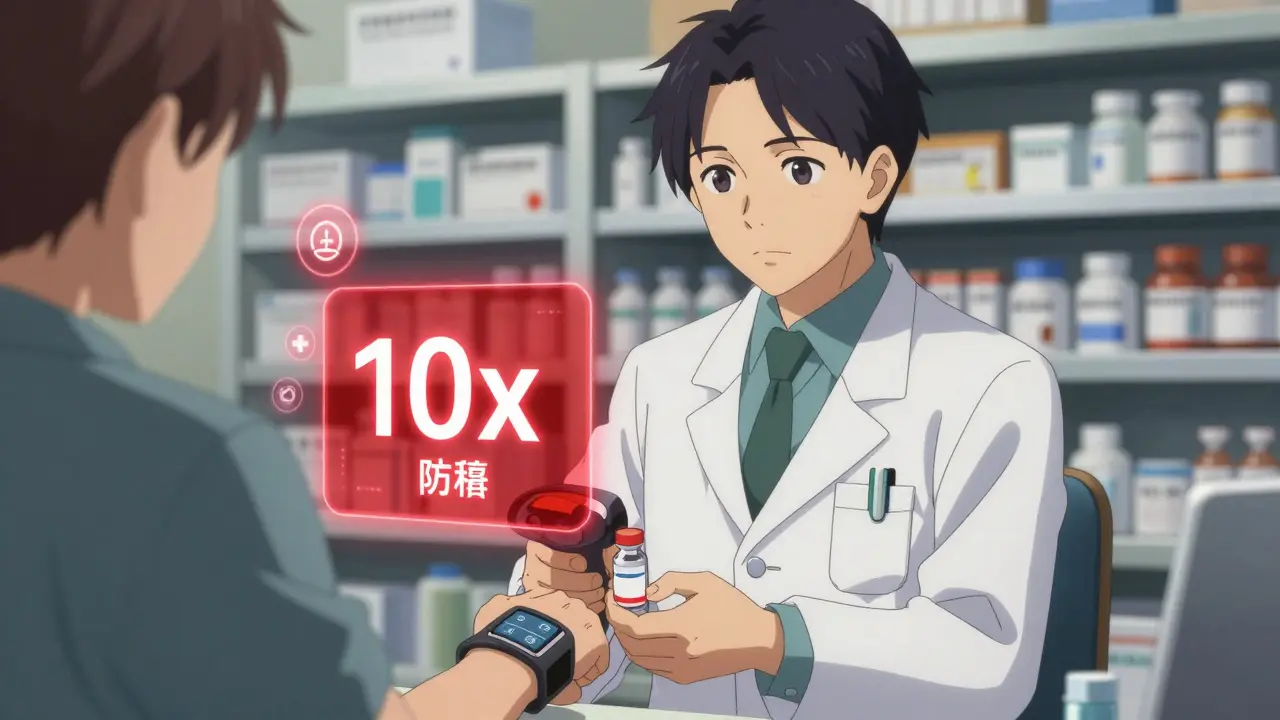
Every year in the U.S., about 1.3 million medication errors happen because someone gave the wrong drug, wrong dose, or wrong patient the wrong medicine. Most of these aren’t caused by bad pharmacists-they’re caused by human mistakes in a fast-paced, high-pressure environment. That’s where barcode scanning comes in. It’s not magic. It’s not fancy AI. It’s a simple, proven system that checks the right patient, right drug, right dose, right route, and right time-every single time.
How Barcode Scanning Stops Errors Before They Happen
Pharmacy barcode systems, also called BCMA (Barcode Medication Administration), work by scanning two things: the patient’s wristband and the medication’s barcode. The system compares what’s being given to what’s ordered in the electronic record. If something doesn’t match-say, a 50 mg pill instead of a 5 mg pill-it won’t let you proceed. No beep. No green light. Just a hard stop. This isn’t theory. In a Pennsylvania hospital, staff accuracy jumped from 86.5% to 97% after implementing barcode scanning. That’s not a small gain-it’s a 10.5 percentage point leap in safety. And across the country, studies show BCMA cuts medication errors by 65% to 86%. For a pharmacy that dispenses 5,000 prescriptions a week, that could mean preventing 30 to 40 dangerous mistakes every single week. The system checks the five rights automatically:- Right patient: Scans the wristband linked to the patient’s EHR.
- Right medication: Scans the NDC barcode on the drug package.
- Right dose: Compares the scanned dose to the prescribed amount.
- Right route: Flags if an oral pill is being prepared for injection.
- Right time: Ensures the medication isn’t being given too early or too late.
Before barcode scanning, pharmacists relied on manual double-checks. Those only caught about 36% of errors. Barcode systems catch 93.4%. That’s more than double the effectiveness.
What’s on the Barcode? NDC, Lot Numbers, Expiration Dates
The barcode on your medication isn’t just a random set of lines. Since 2006, the FDA has required every unit-dose package to carry a National Drug Code (NDC) in barcode form. This unique 10- or 11-digit code identifies the drug manufacturer, product, and package size. That’s how the system knows if you’re holding metformin 500 mg instead of metformin 1,000 mg. Modern 2D barcodes go even further. They can store lot numbers, expiration dates, and even batch information. That’s huge for recalls. If a batch of insulin is pulled due to contamination, the system can instantly flag every patient who received that lot-no manual searching needed. But here’s the catch: not all barcodes are created equal. Ampules, insulin pens, and some compounded medications often have tiny or damaged labels. In 15% of cases, scanners can’t read the code. That’s why scanning isn’t the end of the process-it’s the beginning. When a barcode won’t scan, pharmacists are trained to visually verify the medication against the prescription. Skipping that step is how errors slip through.Why Manual Checks Still Aren’t Enough
You might think, “Why not just have two pharmacists check every prescription?” It sounds safe. But human attention fades. Fatigue, distractions, and interruptions make even the most careful staff miss things. A 2021 BMJ study found that manual double-checks catch only 36% of errors. Why? Because they’re inconsistent. One pharmacist might check the name and dose. Another might skip the route. And in a busy pharmacy, the pressure to move quickly often overrides caution. Barcode scanning removes that variability. It doesn’t get tired. It doesn’t get distracted. It doesn’t assume “this looks right.” It demands proof. And when it finds a mismatch, it forces a pause. That pause is what saves lives.
Where It Falls Short: The Limits of Technology
Barcode scanning isn’t perfect. It can’t detect a mislabeled vial if the label itself is wrong. There’s a documented case where a pharmacy accidentally printed a label for vancomycin 10 mg/mL on a vial of 100 mg/mL. The barcode was correct-so the system scanned it without issue. The pharmacist didn’t visually check the concentration. The patient nearly died. That’s why experts call BCMA a “layered safety system.” It’s not meant to replace human judgment-it’s meant to support it. The technology catches the easy mistakes. The pharmacist catches the ones the machine can’t see. Other weaknesses include:- Non-standard packaging: Insulin pens, IV bags without barcodes, or compounded creams often don’t have scannable labels.
- Damaged barcodes: Heat, moisture, or rough handling can make barcodes unreadable.
- Workarounds: When scanners fail too often, staff start bypassing them. One survey found 41% of pharmacists occasionally skip scans during rush hours.
- Alert fatigue: Too many false alarms (like when a barcode is slightly smudged) make staff ignore warnings.
These aren’t flaws in the tech-they’re flaws in how it’s used. The solution? Better training, better hardware, and strict protocols for when scanning fails.
Real Stories from the Pharmacy Floor
Pharmacists don’t just talk about BCMA in reports-they live with it every day. One pharmacy tech at Kaiser Permanente shared how the system flagged a 10x overdose of levothyroxine. The prescription was for 25 mcg. The bottle said 250 mcg. The barcode matched the bottle. But the system knew the patient’s record called for 25 mcg. It stopped the dispense. The patient, who had a heart condition, could’ve died from that error. On the flip side, a Reddit user described how scanning insulin pens adds 20 minutes to every shift. The barcodes are tiny. The scanner often fails. Staff end up manually typing in codes under pressure. That’s when mistakes creep back in. A 2023 survey of over 1,200 pharmacists found 78% said BCMA reduced errors. But 63% said it slowed them down. And 52% admitted they weren’t properly trained on what to do when a barcode wouldn’t scan. The lesson? Technology only works if people use it right.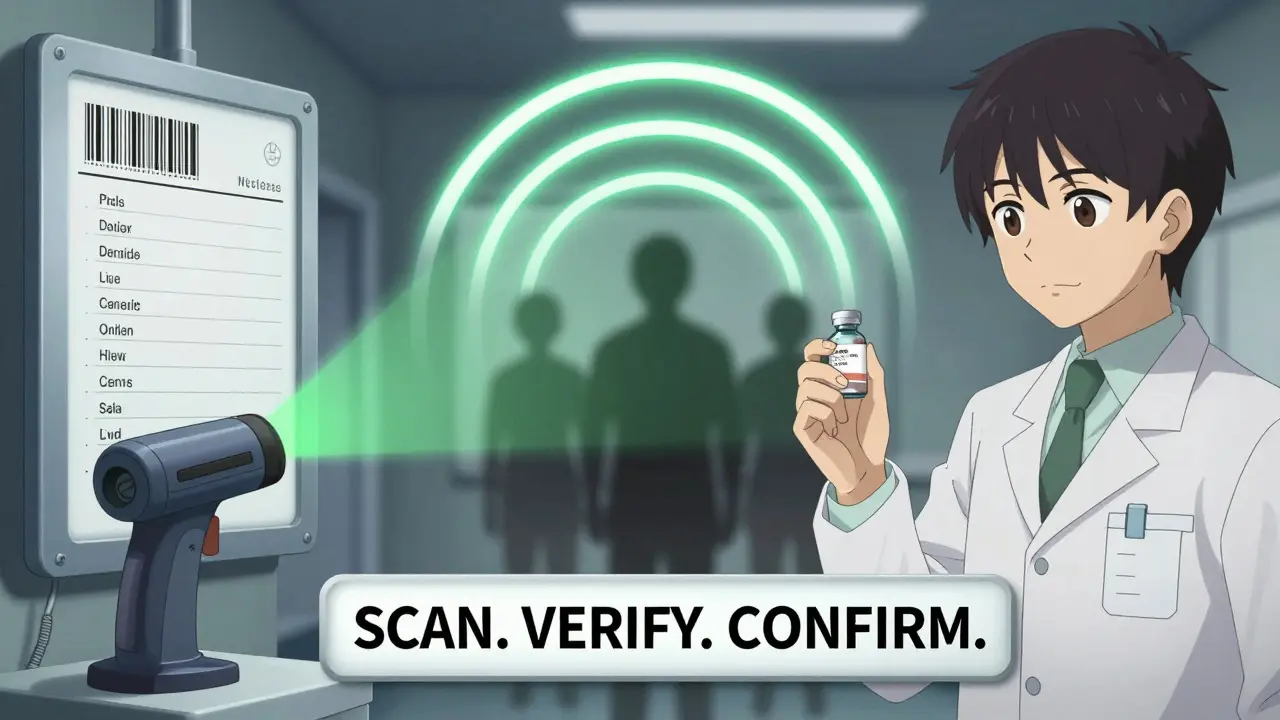
Adoption Rates: Hospitals vs. Community Pharmacies
You’ll find barcode scanning in almost every U.S. hospital with 300+ beds-92% of them use it. That’s because hospitals are regulated, funded, and under pressure to reduce errors. The Joint Commission and CMS require it. But in community pharmacies? Only 35% use it. Why? Cost. A single scanner costs $1,500. Add software, training, and integration with pharmacy systems, and you’re looking at $50,000 to $100,000 for a small shop. Many can’t justify it. Still, the cost of not using it is higher. A single medication error can lead to lawsuits, lost licenses, or worse. Some community pharmacies are starting to adopt it for high-risk meds like warfarin, insulin, or opioids. It’s not all or nothing-they’re picking their battles.What’s Next? 2D Barcodes, AI, and the Future
The future of barcode scanning is moving from 1D to 2D codes. In 2023, only 22% of medications used 2D barcodes. By 2026, that’s expected to jump to 65%. Why? Because 2D codes can store way more data-like patient-specific instructions, refill history, or even temperature logs for refrigerated meds. Vendors are also adding AI. Cerner’s 2025 update will use machine learning to predict when a barcode will fail based on lighting, angle, or label wear. It’ll suggest better scanning positions before the user even tries. But the biggest change isn’t tech-it’s culture. More pharmacies are creating “barcode validation teams” that review scanning failure logs weekly. They look for patterns: Which drugs are most often scanned incorrectly? Which scanners break down? Which staff skip scans? Then they fix the root cause-not just the symptom.What You Need to Do If You Work in a Pharmacy
If you’re a pharmacist, tech, or student:- Scan every time-no exceptions. Even if you’re sure it’s right.
- If the barcode won’t scan, stop. Don’t guess. Don’t type it in. Visually verify the drug, dose, and patient.
- Report damaged or missing barcodes to your pharmacy manager. Don’t ignore them.
- Ask for training on escalation procedures. Knowing what to do when the system fails is as important as knowing how to scan.
- Don’t trust the machine. Trust the process: scan, verify, confirm.
Barcode scanning isn’t the end of medication errors. But it’s the most effective tool we have right now. It doesn’t replace skill-it enhances it. It doesn’t eliminate risk-it gives you a second pair of eyes.
And in a field where one mistake can cost a life, that’s not just good practice.
It’s the standard.
8 Responses
Barcodes aren’t just about preventing errors-they’re about restoring dignity to pharmacists who’ve spent years being blamed for systemic failures. I’ve seen nurses rush through med passes, doctors scribble illegible orders, and techs skip scans because ‘it’s just a pill.’ But when the system stops you, it’s not being annoying-it’s being the voice you wish you’d listened to five minutes ago. This isn’t tech for tech’s sake. It’s accountability wrapped in a scannable code.
Barcodes are just a bandaid on a bullet wound. You think scanning a label fixes human laziness or bad training Or maybe you just like the illusion of control. The real problem is we’ve outsourced judgment to machines because we’re too scared to train people properly. And now we’re surprised when the machine doesn’t catch a label printed on a vial of insulin that says 10mg instead of 100mg because someone thought it looked fine
78% reduction in errors sounds good but what’s the cost per scan How many FTEs are spent fixing scanner failures How many false positives per 1000 scripts What’s the ROI
There’s something quietly beautiful about how this system works-it doesn’t shout. It doesn’t demand praise. It just pauses. That pause is sacred. In a world where speed is worshiped and mistakes are buried under buzzwords like ‘efficiency,’ this little beep that says ‘hold on’ is the most radical act of care we’ve built in decades. It doesn’t replace the pharmacist. It reminds us why we need them. The machine doesn’t care about your shift ending in 12 minutes. It only cares that the patient doesn’t die because someone thought ‘it looked right.’ And sometimes that’s enough.
Been in pharmacy for 15 years. Scanners saved my ass more times than I can count. Still hate the damn things when they glitch at 4pm on a Friday.
Let’s not romanticize this. Yes, barcodes catch errors-but they also create new ones. I’ve seen techs stare at a scanner for 45 seconds while a diabetic patient sweats in the chair because the barcode on the insulin pen is smudged from being tucked in a pocket. And then they just type it in manually because the line’s backed up. So we traded one kind of human error for another kind of human error masked by tech. The real win isn’t the scanner-it’s the culture that says ‘stop, look, think’ even when the system says ‘go.’ That’s what’s missing. Not the hardware. Not the software. The courage to pause.
Biggest win I’ve seen? A new tech started last month and asked why we scan everything. I showed her the story of the 10x levothyroxine error. She hasn’t skipped a scan since. That’s the power of this system-not the tech, but the story behind it. We need more of those stories. Not just stats. Real people. Real near-misses. That’s how you change behavior.
Community pharmacies are stuck between a rock and a hard place. I work in one. We can’t afford scanners for every station, but we use them for high-risk meds like warfarin and insulin. It’s not perfect, but it’s better than nothing. The real tragedy isn’t the cost-it’s that we wait until someone dies before we act. We’re not lazy. We’re just under-resourced. Give us funding. Train us. Then let us do our jobs. The tech works. We just need to be allowed to use it properly.